


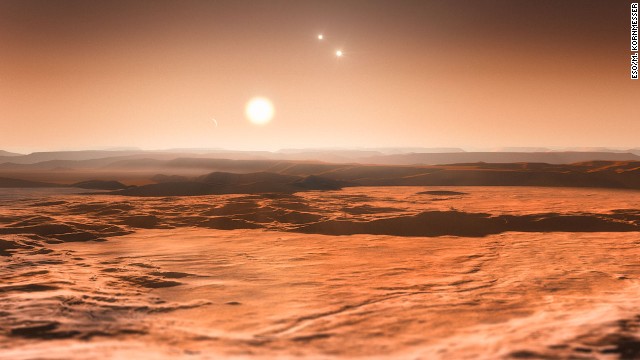
Well, based on sheer numbers, there may be a planet just for you.
Astronomers at the
University of California-Berkeley and the University of Hawaii, using
data from NASA's Kepler space telescope, estimate there are tens of
billions of Earth-size, possibly habitable planets in our Milky Way
galaxy.
Given that there just
more than 7 billion of us on this planet, that means a planet for each
of us with some spares for your picky neighbors. Or a vacation planet or
two for you, maybe.
And the closest may be circling a star you can see if you look up into the heavens tonight.
"When you look up at the
thousands of stars in the night sky, the nearest sun-like star with an
Earth-size planet in its habitable zone is probably only 12 light years
away and can be seen with the naked eye. That is amazing," UC Berkeley
graduate student Erik Petigura, the leader of the team that analyzed
data from the Kepler, said in a press release.
To be sure, the astronomers haven't seen any of the planets themselves. They came to their conclusions like this:
Photos: Where life might live beyond Earth
The Kepler telescope
photographed 150,000 of the 300 billion stars in the Milky Way every 30
minutes for four years. It looked for when orbiting planets passed
between the camera and the star, causing a slight change in brightness
of that star. Analyzing the data, the astronomers say, they found 3,000
planet candidates.
The astronomers narrowed
that number by focusing on just 42,000 stars like our sun or a bit
cooler. That brought the number of planets down to 603. But only 10 of
those were about the size of Earth in the so-called "Goldilocks zone,"
just the right distance from the star where temperatures are suitable
for life as we know it.
So how did they get a
number of planets in the billions? By using a computer model with fake
planets to test the validity of the algorithms used in the calculations.
"What we're doing is
taking a census of extrasolar planets, but we can't knock on every door.
Only after injecting these fake planets and measuring how many we
actually found could we really pin down the number of real planets that
we missed," Petigura said in the press release.
Using the data, the
astronomers calculated that 22% of stars in the Milky Way similar to our
sun have planets like Earth in their "Goldilocks zone." As there are
about 20 billion stars similar to the sun in the galaxy, the
possibilities add up quickly -- more than one for each of us Earthlings.
The researchers do caution, though, that despite being in the habitable zone, a planet could still not be right to host life.
"Some may have thick
atmospheres, making it so hot at the surface that DNA-like molecules
would not survive. Others may have rocky surfaces that could harbor
liquid water suitable for living organisms. We don't know what range of
planet types and their environments are suitable for life," Geoffrey
Marcy, UC Berkeley professor of astronomy, said in a press release.
But the study gives researchers a number to work with.
"The primary goal of the
Kepler mission was to answer the question: When you look up in the
night sky, what fraction of the stars that you see have Earth-size
planets at lukewarm temperatures so that water would not be frozen into
ice or vaporized into steam, but remain a liquid, because liquid water
is now understood to be the prerequisite for life," Marcy said. "Until
now, no one knew exactly how common potentially habitable planets were
around Sun-like stars in the galaxy."
The new study is published in the Proceedings of the National Academy of Sciences
and was discussed this week at the second Kepler Science Conference,
being held at NASA's Ames Research Center in Moffett Field, California.
Also at the gathering, scientists announced the Kepler telescope has found 833 new candidate planets,
including 10 that are of the right size and right distance from their
stars to host life, adding to ones previously confirmed. That brings the
official list to 3,538 planet candidates found using Kepler, according
to a NASA press release. Of those, smaller Earth-sized planets are most
common, NASA said.


0 comments:
Post a Comment