


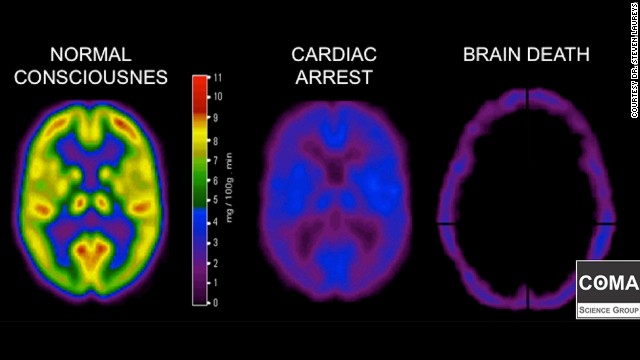
Scans compare neurological activity in a brain that is healthy, one that is comatose and another that is dead
STORY HIGHLIGHTS
- Near-death experiences can be vividly real to those who have them
- Many people who were in comas remember having them
- One need not die to have an out-of-body experience
- Belgian researchers want to see more empirical research on NDEs
It's the perfect day.
You're strolling down a sidewalk, listening to an ensemble of bird
songs, soaking up a balmy breeze fragranced with fresh spring flowers,
and gazing up at a cloudless sky of pure azure.
Pleasantly distracted,
you step off the sidewalk into the street. Brakes screech; horns blare;
people shriek in horror. You snap back to reality ... just as the truck
hits you.
You fly for yards like a
rag doll; you land hard. You're numb all over and fading fast. It's all
over; you know it. Your life flashes before you like an epic movie. The
End.
You leave your body and
look down at it. People are bending over it. Someone is sobbing
uncontrollably. As the ambulance rushes up, a blinding light surges
above you. It beckons you softly.
You follow it through a
tunnel to a place much more vividly real and spectacular than the banner
Sunday afternoon you just left behind. You are sure you have arrived in
the hereafter.
Weeks later, you wake up to the steady beeps of an EKG monitor next to your hospital bed.
The scientific journey begins
If your hospital is in Belgium, Dr. Steven Laureys may pay you a visit, interested to hear what you remember from your NDE, or near-death experience.
He tells you that many people have gone down this road before you and that you can trust him with your experience.
"Patients in intensive
care are scared to tell their stories," he said. They are afraid people
won't take them seriously, especially doctors and scientists.
Laureys heads the Coma Science Group at the university hospital in the city of Liege. He and his colleagues published a scientific study on NDEs late last month.
People who go on these
fantastic journeys are often forever changed. Many seem to come back
happier and no longer fear death, he said. The experience becomes a
cornerstone of their lives.
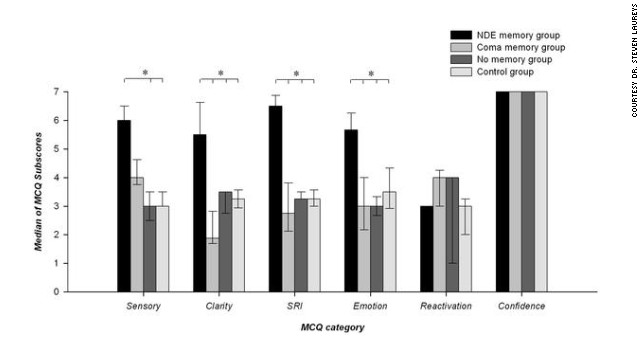 Results of a psychological test reveal memories of Near Death Experiences to be more vivid than any other memory
NDEs feel "even more
real than real," Laureys said. It's this sparkling clarity and living
color of the experience, which many have when they lose consciousness,
that he and his team have researched.
But he doesn't think it
comes from a spirit world. Laureys is a scientist, he emphasizes. He
prefers not to mix that with religion.
His hypothesis is that
near-death experiences originate in human physiology. "It is this
dysfunctional brain that produces these phenomena," he said.
Laureys and his staff
are interested in how the brain creates the mind and its perception of
reality. "Our main focus is consciousness research in comatose
patients," he said. His team hopes to raise the quality of their comfort
and care.
The same story, again and again
Over the years, many patients have awakened from comas to tell Laureys about trips to the hereafter.
Their stories all have elements that are the same or very similar.
"After being close to
death, some people will report having had an out-of-body experience,
having seen a bright light or being passed through a tunnel; all
well-known elements of the famous Near-Death Experience," according to
the study by Laureys and his team of six scientists.
Raymond and Nadine, both
from Belgium, had heart attacks. When oxygen was cut off from their
brains, they had out-of-body sensations, Laureys said.
"I felt as if I were
sucked out of my body at one point," said Raymond. "I was going through a
completely black tunnel, very, very quickly, a speed you cannot
express, because you just don't experience it."
When Nadine's heart
attack came on, she could see herself from outside her body. "It's as if
you are on a cloud, even if it's not really that," she said.
It eluded her control, and that frightened her. She went into a dark hole. "You wonder if you will really return to your body," she said.
A light appeared at the
end of Raymond's tunnel. He, too, was at first afraid and resisted. The
light was female, and she "communicated" with him.
He surrendered to her.
"I realized that I shouldn't struggle, and I let myself go. It was at
that moment that the experience took place."
Psychological test
Scientific research on
people having NDEs is tough, because the exact instant that they occur
is unknown, making them nearly impossible to observe, Laureys said.
It would also be cruel to run brain scans on someone who was possibly facing the moment of death.
So, Laureys and his team
studied the near-death memories of people who survived -- in particular
those of coma patients -- with the help of a psychological examination.
The Memory
Characteristics Questionnaire tests for sensory and emotional details of
recollections and how people relive them in space and time. In other
words, it gauges how present, intense and real a memory is.
They compared NDEs with
other memories of intense real-life events like marriages and births,
but also with memories of dreams and thoughts -- things that did not
occur in physical reality.
The researchers
paralleled new memories with old ones. And they compared the patients
who had NDEs with groups of others who didn't.
Memories of important real-life events are more intense than those of dreams or thoughts, Laureys said.
"If you use this questionnaire ... if the memory is real, it's richer, and if the memory is recent, it's richer," he said.
The coma scientists weren't expecting what the tests revealed.
"To our surprise, NDEs were much richer than any imagined event or any real event of these coma survivors," Laureys reported.
The memories of these
experiences beat all other memories, hands down, for their vivid sense
of reality. "The difference was so vast," he said with a sense of
astonishment.
Even if the patient had the experience a long time ago, its memory was as rich "as though it was yesterday," Laureys said.
"Sometimes, it is hard for them (the patients) to find words to explain it."
True believers
The questionnaire asks
people about their level of certainty that a remembered experience was a
real event and not imagined or dreamed. "They (the patients) are very
convinced that it is real," Laureys said.
A simple Internet search
reveals hundreds of accounts of near-death experiences -- some real,
some perhaps invented. Many people are convinced they are proof positive
that an afterlife exists outside of the physical realm -- and that it
is wondrous.
There are reports of
religious images appearing at times in NDEs, but they are not limited to
one single religion, and they don't always appear. Sometimes Buddha,
Jesus or Mohammed appear, but usually they don't, Laureys said.
Nevertheless, an NDE can
make a convert of a skeptic. Dr. Eben Alexander is a well-known case of
an agnostic scientist who became convinced of the existence of the
spiritual.
He has often shared his story in television interviews with journalists and expressed his views in lectures and in books and video presentations, which he sells on his website.
Alexander, a
neurosurgeon, according to his autobiography, has described his
experience in the same terms as the Belgian researchers:
"hyper-reality," "too real to be real."
In the beginning, he
tried to interpret his experience as a brain function, he wrote on his
website, but he became increasingly spiritual. He has come to the
conclusion that people are reincarnated.
Alexander says his
experience could not have been a hallucination, because the parts of the
brain necessary to produce his experiences were basically dead when he
had them.
It's your brain, Laureys tells you
Laureys strongly disagrees. "There is no evidence there can be conscious experience without brain activity," he said.
Lying in your hospital bed, you have become a true believer, and you are happier for it.
But your brain never
died, the doctor tells you. You were in a coma. Perhaps your heart
stopped for a while; maybe it didn't. But that's not even necessary to
have an out-of-body experience.
"Many individuals having
had NDEs were not physically in danger of death suggesting that the
perception, on its own, of the risk of death seems to be important in
eliciting NDEs," the study said.
It's enough just to think you're dying to have one.
The American
Psychological Association concurs. It defines near-death experiences as
"profound psychological events with transcendental and mystical
elements, typically occurring to individuals close to death or in
situations of intense physical or emotional danger."
In the case of coma
patients, the brain producing the NDE may be functioning minimally, but
it is still alive, Laureys hypothesized. He said one can stimulate
certain parts of the brain to produce single elements of the experience.
It's a vivid
hallucination, Laureys' report surmises. "It was a normal brain activity
that produced their extraordinary perceptions."
Needs more research
Though the results of
his studies were marked and consistent, the Belgian research team has
tested only a small number of patients so far.
And it has not been able
to scan brain images of patients having NDEs to get hard data on the
hypothesis of the physiological nature of the experience.
Laureys' research alone
is not enough. He wants to see more scientists get involved. As a
doctor, he feels it's the compassionate thing for them to do.
Too many people have the
experience for serious researchers to ignore it, he said, and a lot of
people are afraid that their consciousness will linger long after they
pass away, making them witnesses to whatever happens to their bodies.
"The public is
historically afraid to be buried alive," Laureys said. "People are
afraid to sign up as organ donors." They are scared they may have to
watch them being extracted from their bodies.
There are more than
enough spiritual models for NDEs, he said -- and superstitious ones.
"There are a lot of crazy explanations out there."
It's high time for more
hard science, Laureys said. A high percentage of his coma patients
report having had NDEs, and he believes many of us go through these
"afterlife" experiences when we die.
Laureys doesn't want to
speculate on the existence of heaven or hell, but he does say that only a
small minority of near-death experiences are horrifying. Most of them
are pleasant and uplifting.
From his accounts, it sounds like more people go to "heaven" than to "hell."


0 comments:
Post a Comment