


 (CNN) -- For a big chunk of the Cold War, the U.S.
Air Force turned to the SR-71 Blackbird for many of its most important
spy missions. The jet-black jet could fly at more than three times the
speed of sound at altitudes of 85,000 feet, faster and higher than
anything adversaries had to counter it.
(CNN) -- For a big chunk of the Cold War, the U.S.
Air Force turned to the SR-71 Blackbird for many of its most important
spy missions. The jet-black jet could fly at more than three times the
speed of sound at altitudes of 85,000 feet, faster and higher than
anything adversaries had to counter it.
The last of the Blackbirds flew in 1999, and the U.S. military hasn't had anything close since.
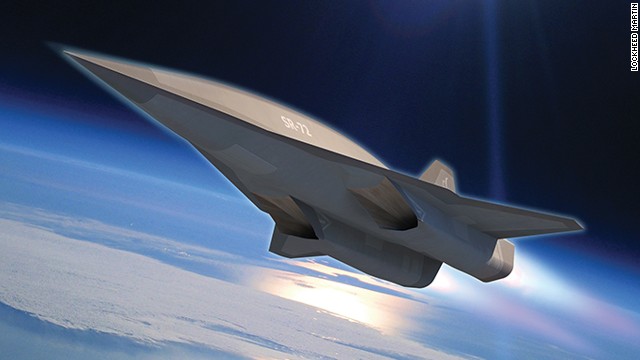
Now, Lockheed-Martin, the
maker of the SR-71, says the "Son of the Blackbird," the SR-72, is in
the works, and it will be twice as fast as and way more lethal than its
father. That's because the SR-72 will be designed to launch missiles,
something the SR-71 didn't do.
"Even with the SR-71, at
Mach 3, there was still time to notify that the plane was coming, but at
Mach 6, there is no reaction time to hide a mobile target," Brad
Leland, Lockheed Martin's program manager for hypersonics, told Aviation
Week and Space Technology. The publication provided the first detailed look at the SR-72 plans last week.
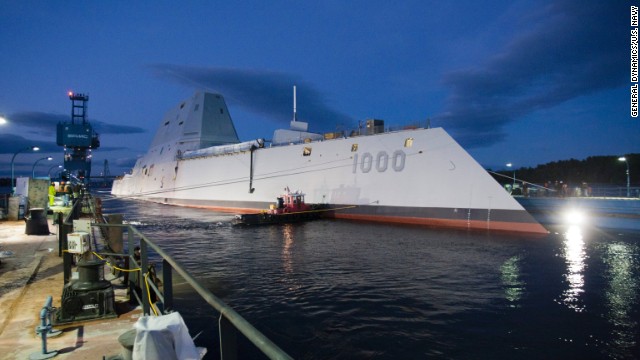 Photos: U.S. Navy's new stealth destroyer
"Hypersonic aircraft,
coupled with hypersonic missiles, could penetrate denied airspace and
strike at nearly any location across a continent in less than an hour,"
Leland said in a news release.
And, by the way, the
SR-72 is envisioned as a drone, unlike the original Blackbird with its
crew of two: a pilot and a reconnaissance officer to operate its radar
jammers and spy gear.
"The SR-71 was developed
using 20th-century technology. It was envisioned with slide rules and
paper. It wasn't managed by millions of lines of software code. And it
wasn't powered by computer chips. All that changes with the SR-72,"
Lockheed Martin says.
CNN Explains: Drones
A smaller-scale model of the SR-72 could begin testing in five years and be in the air in 10, Leland told Aviation Week.
The full-scale SR-72 could be operational by 2030, according to Lockheed Martin.
If it comes to fruition,
one thing the SR-72 won't be is stealthy. The design needed for the
Mach 6 speed doesn't allow for such construction, according to the
Aviation Week report.
"Speed is the new
stealth," Aviation Week quoted Al Romig, engineering and advanced
systems vice president at Lockheed Martin's Skunk Works division, as
saying.
"Speed is the next
aviation advancement to counter emerging threats in the next several
decades. The technology would be a game-changer in theater, similar to
how stealth is changing the battle space today," Leland said in the
statement.
Of course, none of this will fly without money, and that will probably be up to taxpayers.
"We have been continuing
to invest company funds, and we are kind of at a point where the next
steps would require large-scale testing, which would significantly
increase the level of investment we've had to make to-date," Leland told
Aviation Week. "Between DARPA (Defense Advanced Products Research
Agency) and the Air Force, it would be highly likely they'd have to fund
the next steps."


0 comments:
Post a Comment