


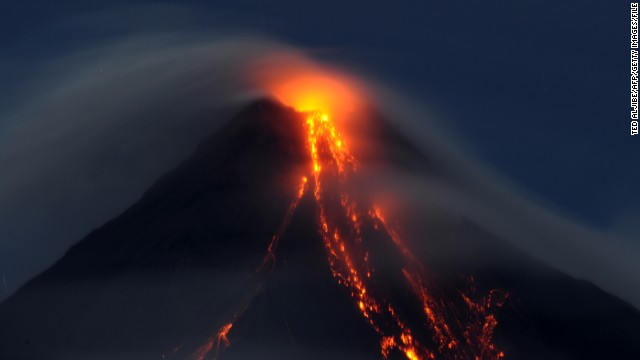
 From volcanoes to wave power and
even algae, researchers are looking far and wide for viable energy
alternatives to power the planet after oil, gas and coal reserves run
out. We take a look through some of the more interesting, promising and
downright unusual possible energy sources of the future. Gallery by Matthew Ponsford
From volcanoes to wave power and
even algae, researchers are looking far and wide for viable energy
alternatives to power the planet after oil, gas and coal reserves run
out. We take a look through some of the more interesting, promising and
downright unusual possible energy sources of the future. Gallery by Matthew Ponsford
HIDE CAPTION
Energy from...
STORY HIGHLIGHTS
- Researchers are looking for alternatives to fossil fuels
- Former NASA engineer John Mankins plans to put solar power plant into space
- UK, France, Portugal and U.S. world leaders in wave power
- Danish inventor Jens Dall Bentzen creates biomass furnace that can burn wet wood
Some estimates suggest we have about 70 years of coal, gas and oil left; the fossil fuel industry itself insists that we have significantly longer. But everyone agrees they will run out in due course.
So how will the world be
powered when we can't rely anymore on fossil fuels? Why with volcanoes,
waves, wet wood and solar power from space.
To compensate for the
decline of traditional energy sources, researchers around the world are
developing innovative new technologies that -- between them -- may
provide a long-term solution to our rapidly growing energy needs. Some
are familiar, some may seem far-fetched, and some could potentially pose
as much of a threat to the environment as fossil fuels themselves.
 One man's waste, another man's energy
CNN takes a look through some of the more interesting and unusual energy technologies currently under development.
Solar energy from space
The idea of collecting
solar power from space has been under consideration since the 1970s.
Putting solar panels into orbit offers a few obvious advantages over
regular solar power such as not having to deal with atmospheric
interventions (cloud cover and atmospheric gasses) and not losing any
productivity at night.
In the past, trying to
get a power plant to the edge of the Earth's atmosphere seemed deeply
unlikely. But John Mankins, a former NASA engineer now with the Artemis
Group has been working on a project that he believes will make such an
audacious idea simple:
"The basic concept of
the Solar Power Satellite (SPS) is to deploy a large platform in space
near Earth," Makins says, "typically in a high orbit where the sun
shines almost constantly, where it would harvest sunlight, convert it
into electricity and then transmit it to receivers on Earth for use."

Some have suggested that
lasers could be used to transmit the energy from space. Mankins says
that in his view this is possible, but potentially dangerous ("think
about the Death Star" he said ominously in an interview with Motherboard). Instead his project aims to use low-intensity microwave transmitters, which he believes will be safer.
Mankins says that the
energy yield from a solar power satellite could be significant,
potentially delivering up to 1,000-2,000 MW of power to the Earth.
To put it into
perspective, he says "a typical home in the U.S. requires about 4-5 kW
of power, or about 100 kW-hours per day, or about 3,000 kW-hours per
month, or about 36,000 kW-hours per year. So a single SPS ... would --
for example - deliver power / energy for roughly 240,000-480,000 homes."
Some critics say the project would be prohibitively expensive
or that getting something so large into space presents challenges.
Others note that the energy yield is still not high enough to make the
project worthwhile. Still, the fact that it is being considered by NASA lends it significant weight. So perhaps it is not so out of this world after all.
Mining volcanoes for power
Last year, work began on
a new plan to extract heat from the hot rocks that lie under and around
volcanoes. By injecting water into cracks in the ground, researchers
hope that they may be able to create steam to power subterranean
electricity turbines.

The basic concept of the Solar Power Satellite (SPS) is to deploy a large platform in space near Earth, to harvest sunlight
Two companies, AltaRock
Energy and Davenport Newberry, were granted permission to test this
procedure in the land around the Newberry Volcano in Oregon, in a
process that critics argue is not dissimilar to the controversial
technique of hydraulic fracturing.
Over the past 12 months
hydraulic fracturing or fracking has been the subject of protests around
the world, but in fact it has been around since the 1960s. The CEO of
AltaRock, Susan Petty, said in a company blog post
that "creating multiple reservoirs from a single injection multiplies
the amount of energy that can be extracted from each production well,"
and will "extend the life of the well and increase the energy recovery
from each well, significantly improving the economics of enhanced
geothermal system power generation."
But fracking is known to potentially generate earthquakes, and -- as noted by Wired magazine -- practicing a similar technique beneath a volcano that the U.S. Geological Survey says "is certain to erupt again" seems an odd choice.
Whether the technique
can yield significant energy return, and be conducted safely is still a
matter of debate as heated as the Newberry volcano itself.
Wave energy

Wave energy is already
being used across the world. Billions of dollars have been invested in
the technology and the world's first "wave farm" opened near Porto in
Portugal in 2008. At the European Marine Energy Center in Orkney,
Scotland, the world's biggest wave farm was approved for construction
earlier this year. The 40MW farm off the north-west coast of Lewis
promises to deliver enough energy to power nearly 30,000 homes.
Wave farms deploy
massive buoys to turn the motion of waves into power. Aquamarine Power
the company running the project in Orkney, says that its huge yellow
buoys have "a maximum generating capacity of 800kW." The bright yellow
machines measures 26 meters across and are installed at a depth of
around 13 meters, around 500 meters from the shore.
The advantages of wave
power are similar to those of wind -- the waves are free -- but there
are some additional benefits. In particular, it's easier to forecast
wave energy output, because waves are driven by wind, but don't vary as
rapidly; they build up more slowly and dissipate more gradually. That
makes the energy from waves more predictable than that from wind or
solar, which means that it is easier to integrate into the power grid.
At present the UK is the world leader in the technology, with the U.S., Portugal and France also significant players.
Pocket particle accelerators
Researchers working in a
laboratory in Daresbury, UK believe that their pint-sized particle
accelerator -- like the Large Hadron Collider in Switzerland but much
smaller -- could offer a genuine alternative to fossil fuels. Powered by
thorium, a naturally occurring radioactive substance, the small scale collider could generate significant amounts of energy.
The Mail on Sunday estimates that just one ton of thorium could "produce as much energy as 200 tons of uranium, or 3.5 million tons of coal."
In the year 2000, most alternative energy technologies were
considered niche options -- now they're multi-billion dollar industries
William McDowall, UCL Energy Institute
William McDowall, UCL Energy Institute
"The idea of thorium reactors is one that is under a lot of discussion these days; clearly the physics will work," says Mankins.
But he notes that there are always hazards in using nuclear material.
"Even though it
certainly would be safer than past nuclear reactor approaches, it seems
likely to me that governments are not going to want a lot of radioactive
material on the highways."
Wet leaves and damp wood
Biomass power involves
the breakdown of biological material -- such as leaves and wood -- to
produce gasses like hydrogen and methane, which in turn can be burned.
The problem with some
existing biomass power plants is that they need the biological materials
to be dry. Jens Dall Bentzen, a Danish inventor, has come up with a new
type of biomass furnace that can trap moisture from damp materials and
export it as hot water. Dall Benson believes this could allow his new
furnace to generate up to 30% more energy.
"What's unique about
biomass," says Dall Bentzen, " is that you can store it. You never
really know when the wind is blowing. With biomass we have the control
to use it when we need it."
"Wind is the resource we
have most of in Denmark," Danish Climate and Energy Minister Martin
Lindegaard told CNN, "and we need biomass and biogas to have the back up
for when the wind stops blowing."
Critics argue that
burning biomass contributes carbon dioxide to the atmosphere, but its
proponents suggest that such damage can be offset by growing crops specifically to be burned.
A viable alternative?
With biomass we have the control to use power when we need it.
Jens Dall Bentzen, Danish inventor
Jens Dall Bentzen, Danish inventor
One of the most
substantial indicators of the viability of alternative energies can be
seen in the growth in investment from venture capitalists and other
private investors.
William McDowall, from
the University College London Energy Institute, notes that venture
capital investments in clean energy went from less than $100 million a
year in the late 1990s to over $10 billion a year in 2011.
"In the year 2000, most
alternative energy technologies were considered niche options that might
one day show promise -- now they're multi-billion dollar industries,
significant enough to precipitate serious trade disputes between the US,
EU and China," McDowall says.
Government investment
has shown a similar pattern, but significant public and private sector
research money is still going into fossil fuels. New extraction and
processing technologies for coal, oil and gas are still the main focus
of private sector research and development.
However many experts,
McDowall included, believe that this may change by 2025 when alternative
energies could finally stop being regarded as "alternative."
-CNN


0 comments:
Post a Comment