


 It's GimBall, a flying robot that could change the face of search-and-rescue missions.
HIDE CAPTION
Is it a bird? Is it a plane?
STORY HIGHLIGHTS
- Introducing GimBall, the flying robot that moves like a fly
- The machine features a protective cage that lets it bounce off surfaces
- Includes a small in-built camera
- Swiss scientists hope it will be used in search and rescue missions in the future
Art of Movement is CNN's monthly show exploring the latest innovations in art, culture, science and technology.
(CNN) -- For most of us, watching a fly mindlessly
bouncing against a window in an effort to escape, is pretty annoying --
perhaps even infuriating.
For a team of Swiss scientists, this stubborn maneuver could change the face of search-and-rescue missions forever.
Introducing GimBall
-- a spherical flying robot encased in a flexible cage, which allows it
to happily smash into surfaces while navigating disaster sites.

Bounce back
Unlike other rescue
robots, where colliding with obstacles could easily spell the end of an
expedition, GimBall is able to bounce back without losing its bearings
or damaging its in-built camera.
The futuristic floating ball is the brainchild of scientists at the Swiss Federal Institute of Technology (EPFL),
and it's hoped that one day it will be used for everything from
searching for survivors to measuring gas leaks in collapsed buildings.
"We were wondering why
insects were so capable of going inside any building -- yet had limited
senses such as eyesight," explained co-creator Adrien Briod.
"One capability that was
completely overlooked was their ability to collide into surfaces. For
insects this isn't a big deal -- but it is for robots."
Flying to the rescue
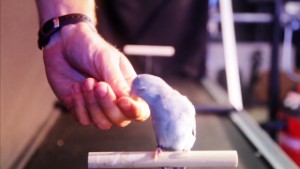 Flying robots inspired by birds?
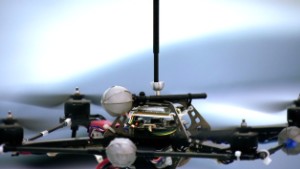 Flying robots perform amazing acrobatics
Indeed, one of the first
major search-and-rescue missions to use robots was in the aftermath of
the September 11 attacks on New York's Twin Towers -- an area deemed too
dangerous or inaccessible to humans.
However, the ground-dwelling machines sometimes found it difficult to negotiate the collapsed World Trade Center, becoming stuck in the rubble.
In the last decade,
robotics has come a long way, with scientists increasingly looking at
the benefits of flying machines in disaster zones.
"A ground robot will
very quickly be limited -- even a staircase is difficult. If you need to
reach people on the fifth floor of a building, it won't be able to do
it," said Briod.
"Flying allows you to
overcome large obstacles. And it provides an elevated point of view --
it's very useful to have an image of the scene from eye level, than from
the floor."
Clever design
So how does Gimball
work? With a 37 centimeter diameter, the robot is a little larger than a
basketball. Featuring a stable inner frame, and a rotating outer frame
made of 90 flexible carbon rods, it is able to bounce off surfaces
without damaging the machine.
While other robots might need heavy sensors to help avoid collisions, GimBall keeps things light, weighing just 370 grams.
Two propellers help it
fly along at 5 kilometers per hour, with enough battery power to last
five minutes. It can either be remote controlled, or fly autonomously,
sending back footage to operators.
We were wondering why insects were so capable of going inside any building -- yet had limited senses such as eyesight.
Adrien Briod
Adrien Briod
Briod now hopes the
pioneering design will be used in real lifesaving missions within the
next year, and said we were on the brink of a new era in technology
where drones were used in everyday life.
"Up until now, the
military had all the drones out there, but in the last few years there's
been a huge development in civilian use," he said.
"Technology is
developing really fast in the field of remote control -- drones are used
in rescue missions, fire, or inspecting unstable buildings, bridges,
and boats."
Sci-Fi future
The research team
recently took GimBall for a spin in a Swiss woodland, watching it smash
into trees, roll along uneven ground, and negotiate branches -- all
without damaging its inner workings.
It appeared like a rogue
alien aircraft that had been left behind on a mission to Earth. So what
is it about flying robots that continues to capture our imaginations in
a way few other pieces of tech can?
"It's not limited to 2D -- that's what fascinates people, this freedom to move in the third dimension," said Briod.
"And seeing your creation flying is extremely satisfying."
-CNN


0 comments:
Post a Comment