Follow us

Pages

Friday, 29 November 2013

Facebook Will Let You Save Links to Read Later

159539865
Mark Zuckerberg has described his social network as a "personalized newspaper" — and for seasoned users with a wide-range of like-minded friends, it's hard not to argue that the articles that pop up in your news feed constitute the most engrossing read in the world, if not exactly the most timely one.
But Zuckerberg also knows you could be reading Facebook more in any given day. What about those times when you're just skimming the app during a spare minute? What if you don't have time to read any of those fascinating links?
If you've ever gone hunting through your feed for an article you saw earlier, you'll welcome the news that Facebook appears to be testing a "save for later" feature. This isn't the first time the company has tested the idea, but it does appear to be more advanced and closer to wide release.
The concept first cropped up on a version of the Facebook app for iPhone and iPad in 2012. In that iteration, you held your finger on a story to save it to a separate list. Now, according to the blog MyTechSkool, which first spotted it, users will see a button with a bookmark icon they can press.
This is what apps such as Instapaper, Pocket and Read It Later have been doing for years, of course. The Apple browser, Safari, added a similar feature called Reading List (available on mobile in iOS6 and on the desktop with Mac OS X Mavericks).
But the Facebook feature differs in significant ways. First of all, you can save more than just articles — in theory, you'll be able to set aside anything from your cousin's holiday snaps to a change in your secret crush's relationship status. Call it a social To Do list.
Secondly, it allows you to do your later reading within Facebook — meaning Zuckerberg gets to monitor and monetize ever more of your reading behavior. What we don't know yet: whether you'll be able to read those articles, links and saved social snippets when you're offline.
We've reached out to Facebook to find out when the company intends to roll this out to all users. In the meantime, let us know in the comments below whether you see the Saved feature yet.

-Mashable

Everything You Need to Know About Gmail's Latest Update

Gmail
Gmail had a little work done lately, and it's looking good.
The latest version of the web's favorite email client comes with a host of new features, ready to help you reach Inbox Zero. But with new updates rolling out every month or so, it's hard to keep track of the latest tools. Just when you think you know it all, one little change can completely impact your whole experience.
We've rounded up the latest features so you can reclaim your title as Gmail Master. Here's the definitive guide to the latest updates.

1. Download Attachments to Google Drive

A major change, new Gmail revamped its attachment UI. Instead of downloading attachments to your desktop's Downloads folder — and honestly, who knows what you've lost in that mess — you now have the option to save everything straight to Google Drive. You can even send the download to a specific folder within Drive.
Now save email attachments straight to Google Drive.
Image: Google You can also preview multiple attachments easily within Gmail, read whole documents, or even search for a specific word or phrase within a convenient popup window.
You can now easily preview documents in Gmail.
Image: Google

2. A Little Less Conversation, a Little More Action

Another change to the Gmail interface is the new action buttons feature. These buttons appear in your Inbox to the right of email subjects. They scan the contents of your emails for pertinent information, such as dates or flight information, so you can complete tasks, for example, reviewing your Seamless orders, booking reservations or checking flights without having to even open the email.
Gmail Action Buttons make it easy to complete tasks without opening an email.
Image: Google Google stresses that the action buttons do not inherently share personal information and will only link with services that you've already connected to your Gmail account.

3. Nothing Like a Handwritten Note

Although Google products support a wide range of languages, if you're constantly switching between different alphabets, the keyboard can be a pain. Now you can write out characters in your own hand using your mouse or trackpad, to be converted into text using Google's new input tools.
Inputting special characters is easier than ever with Google's new input tools.
Image: Google With over 20 languages currently available in Google Docs and 50 languages in Gmail, your message is sure to translate.

4. A New Home for Your Apps

All your Google applications got a new home in the upper right-hand corner of your inbox. Simply click the apps icon to easily access your Drive, Calendar, Google+, Contacts and Groups. From here, you can also access your Google+ profile, any other Gmail accounts you're logged into (by clicking on your picture icon) or just your Google+ notifications, by clicking on the bell.
All of your Google Applications can easily be accessed at the click of a button.
Image: Google

5. Updated iPad Look

For iPad users, the latest Gmail for iOS app just got a major overhaul, giving you more room for serious multitasking. Holding your iPad in landscape mode gives you a new navigation bar on the left-hand side, where you can switch between the new inbox categories (or your other Gmail accounts) with one tap.
The new Gmail for iPad app gives a new left hand navigation bar.
Portrait mode has also changed, giving you a closer look at each individual message by isolating it on the page in it's own full-screen view. That also means more room to compose new messages. You can download the latest version of the iOS app now from the App Store.

6. A Sleeker Login

While not the most dramatic of changes, Google has started rolling out a new design for its login page, putting the login form front and center and eliminating everything else on the page.
New Gmail Login is sleek and to the point.
Image: Google The new login page is similar to the mobile login page and emphasizes how many tools a user gets with a single login.

-Mashable

Monday, 25 November 2013

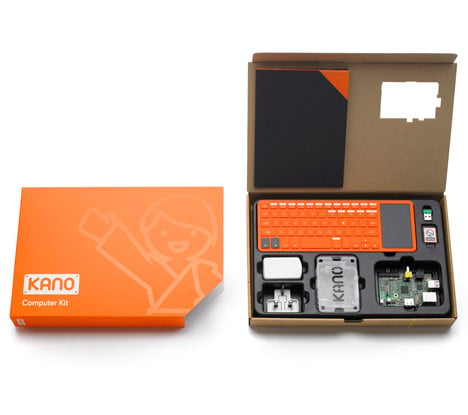
Kano Computer Kit Lets Anyone Build a PC From Scratch


If you grew up tinkering with building kits like Erector sets or Lego Mindstorms, you can probably appreciate how important such tools can be to a child’s early development.
Now, a Kickstarter team has created something similar that enables kids and adults alike to learn more about computers.
Kano is a computer kit designed to help people of all ages assemble a computer from scratch, and learn basic coding skills.
Powered by a Raspberry Pi computing module, the kit includes two instruction manuals, a custom case, an 8GB SD card, a keyboard, a speaker, a power plug, and HDMI and mini-USB cables.
For the kit's coding component, the team developed Kano OS, a distribution of Debian Linux, as well as Kano Blocks, a visual programming dynamic that allows users to develop with code blocks and then output the results in Javascript or Python for use in game programming or other areas.
The project began with a simple, Lego- and manga-inspired book last year. For its name, the team took on the moniker of famed Japanese judo instructor, Kano Jigoro, as a nod to his role as a dedicated teacher.
Launched as a Kickstarter project with the goal of securing $100,000 in funding, the project has already raised more than $580,000 at the time of this writing.
The kit, which costs $119, is scheduled to ship worldwide in July 2014.

-Mashable

Honey Bees Trained to Detect Cancer on Patients' Breath


Doctors have long treated patients for exceptionally bad bee stings, but now, it looks like the insects may be helping the field of medicine.
New research from Inscentinel, a UK-based firm specializing in insect research, suggests that honey bees can be trained to detect certain early-stage cancers in humans.
Using this breakthrough, Portuguese designer Susana Soares has developed a glass device for diagnosis using honey bees and a patient's breath.
Thanks to their super-sensitive sense of smell, bees can detect odors that a human nose can't, Soares explains on her website. Biomarkers associated with tuberculosis, lung cancer, skin cancer and diabetes, which can all be detected through smell, are present on a patient's breath.
Soares designed a glass objects with two enclosures: a small chamber that the patient breathes into and a larger chamber where trained bees are kept. If the bees detect the odor they where trained to pinpoint - in this case that of disease biomarkers - they'll rush into the smaller chamber where the breath is.
The cancer-detecting bees are trained by exposing the insects to the smell, then feeding them sugar, so they associate the odor with a food reward.
Soares says that properly trained bees are "very accurate" in early medical diagnosis.

Tuesday, 19 November 2013

Facebook Messenger App Upgrade Available to All iOS, Android Users

Messenger-app-3
The Facebook Messenger app update the company announced in late October is now available to all iOS and Android mobile users.
The update was originally rolled out to a small group of Android users only.
The most notable update to the app allows users to message anyone in their contacts who has the Messenger app, not just those they are Facebook friends with. The speed of messages also improved, meaning the app works much more like SMS or texting than it did before, said Peter Martinazzi, the Messenger product manager at Facebook.
The new versions of the app were also built specifically for Android and iOS operating systems, meaning the icons, color schemes, and layouts were designed to feel more natural on each OS, said Martinazzi.

-Mashable

Monday, 18 November 2013

BBM app now available for iPad and iPod

After conquering the hearts of many iPhone and Android phone users, the BlackBerry Messenger (BBM) app is now targeting as iPad and iPod owners as potential users.
 
In a blog post, BlackBerry said its update to the iOS app now has support for the iPad tablet and iPod media player, so long as they can use WiFi.
 
BlackBerry also said a new update has rolled out for Android devices as well.
 
"In addition to several new features, bug fixes and performance improvements, we are also proud to deliver something you’ve been asking for: support for iPod and iPads!" it said. http://blogs.blackberry.com/2013/11/bbm-for-android-and-iphone-updates-now-available/
 
The features for the updated BBM app for iPhone include:
 
- Support for iPod and iPad devices running iOS6 and iOS7
- Improvements to right-to-left language support
- More options for sharing your BBM PIN Barcode
- Find your friends on other social networks who are also using BBM
- Fixes an issue where some users would be missing BBM contact names
 
Meanwhile, the new features for the updated Android app include:
 
- Support for BBM Contact Categories
- BBM Group List sorting and filtering improvements
- More options for sharing your BBM PIN Barcode
- Find your friends on other social networks who are also using BBM
- Addresses an issue where some users may have experienced higher battery use
 
BlackBerry also said the update introduces the new Share PIN option to make sharing a PIN Barcode even easier.
 
"Using this option you can quickly share your PIN Barcode across your favorite social network as well as other options provided by your device’s operating system," it said.
 
Another new feature is "Tell Your Friends," which lets a user see which of his or her friends on other social networks are also using BBM, so he or she can invite them to chat.
 
A separate article on TechHive.com said the updated app works on both Wi-Fi-only iPads and ones with cellular capability.
 
It added BBM's usage numbers show people may be interested in the app even if they do not own a BlackBerry device.
 
"Before BlackBerry Messenger rolled out to the iPhone and Android-based devices, it had 60 million users, and now it has 80 million, BlackBerry said," it added. — KDM, GMA News

Google Announces New Measures Against Child Pornography

Eric-schmidt
Google's executive chairman Eric Schmidt has announced the company will start to globally block links to child pornography material within the next six months.
In an op-ed in British newspaper Daily Mail, Schmidt said Google has assembled a team of more than 200 experts working on new technology to address this problem. As a result, Google will prevent links to child sexual abuse material from appearing in search results. The company will also show warnings at the top of more than 13,000 search results, explaining that child sexual abuse is illegal and offering advice on where to get help.
Furthermore, a technology that identifies child sexual abuse videos on YouTube is undergoing testing right now.
These measures are currently live in English-speaking countries, but they will be expanded to the rest of the world, covering 158 other languages, within the next six months.
"While no algorithm is perfect – and Google cannot prevent paedophiles adding new images to the web – these changes have cleaned up the results for over 100,000 queries that might be related to the sexual abuse of kids," wrote Schmidt.
Schmidt still maintains that, when it comes to detection of child sexual abuse imagery, there is no easy technical solution that can help. Instead, a real person has to review the images, and those that are found to be illegal will be given a special digital fingerprint so Google's computers can identify them when they appear on its systems.
The move comes after a heated campaign for stopping child porn in Britain.
"Google and Microsoft have come a long way," UK Prime Minister David Cameron told Daily Mail. "A recent deterrence campaign from Google led to a 20 per cent drop off in people trying to find illegal content, so we know this sort of action will make a difference," he said.
Although he believes this is a move in "the right direction," Cameron wants an even bigger commitment from these companies.
"If the search engines are unable to deliver on their commitment to prevent child abuse material being returned from search terms used by paedophiles, I will bring forward legislation that will ensure it happens," he said.

-Mashable

TapTap Wristband Connects Couples With Wireless Vibrations

TapTap wristbands
Nowadays you can reach whomever you want through various modes — a Facebook message, a tweet, a text message and a phone call, just to name a few. These all require you to look at a screen in order to process what another person wants to communicate.
But now Woodenshark is offering a device called TapTap, a wristband meant to help people communicate without the need of a screen. Targeted toward people in a relationship, the wristband allows users to communicate through — you guessed it — taps. One user taps the wristband and the other feels the wristband vibrating as it relays those taps.
For $130, you get two wristbands, which can run up to seven days on one charge, according to the company. To use the wristband, you download an app and connect it to your email along with the email of the person wearing the other wristband.

The product works with Android smartphones with Bluetooth 2.1 and above, as well as the iPhone 4S and newer. The silicon wristband holds a plastic module in place, the brain of the TapTap, so to speak. A capacitive sensor and an accelerometer sense the taps. The bracelet also includes LED lights to alert you of any missed taps or a low battery.
Woodenshark's wristband also comes in variety of patterns. To change your look, you just take the module out of one wristband and place it into another.
Dmitry Gorilovsky, founder of Woodenshark, told Mashable that although the wristband primarily focuses on people in a romantic relationship, people have already proposed other uses. The company's Kickstarter campaign has helped the team consider some of the proposed alternative uses.
"People can create their own language," he said. "We are testing TapTap with our close circles like friends and family and some couples they use just two or three different ways of tapping each other with different meanings. Like, one tap 'I am missing you' and several taps in a row 'just take a look at your phone or check something, I'm writing.'"
TapTap wristband
The team is also working on configuring the TapTap to work with smart alarms and game controllers by using different apps on the smartphone. The focus, however, remains on interactions between two wristbands.
At the time of this writing, the team had raised $74,888 out of a $130,000 goal. The campaign ends Nov. 22.

Sunday, 17 November 2013

LG G2: A Better Smartphone Than the Samsung Galaxy S4

Show As List
Mashable Choice highlights the products and services we've tested and would recommend to others. Consider it Liked, Favorited, +1'ed and Pinned.
It's funny how quickly we get used to ergonomic paradigms. What I mean is, we quickly got used to a smartphone's On/Off button being on the top or right side with the volume button on the left side. Lord help the handset maker who screws with this time-honored six-year old smartphone button arrangement.
Well, Lord help LG, because it has moved all these keys from their usual perimeter positions to the rear of its latest superphone, the G2. In an age of Android androgyny, this shift is jarringly deliberate, designed to clearly differentiate the G2 from other Android superphones, specifically those from LG's mortal enemy, Samsung and its Galaxy S4.
Oddly, LG needn't have bothered with such an obvious ergonomic deviation. In nearly all everyday usability aspects, the G2 one-ups the Galaxy S4, including ease of calling, camera and battery life.

Rear vs. Side

LG's stated reason for moving the volume and On/Off toggle to a rear array under the camera lens is to make it more natural to raise and lower the volume of conversation while holding the G2 to your ear. And LG is correct — it’s a mite easier to manipulate the up/down buttons from this rear position — but not enough to overcome some of this arrangement's deficiencies.
For starters, the rear buttons makes it more awkward to wake up or put the G2 to sleep.
For starters, the rear buttons makes it more awkward to wake up or put the G2 to sleep. Because the on/off key is wedged between the up/down toggle, because of the G2's lack of a physical home button and because of the G2's girth, it's not as easy to quickly locate the sleep key by feel. And if you lay the phone on its back while a call is in progress or you're watching a video, you risk hitting the rear sleep key.
Instead of searching for and tapping the rear sleep key, you tap the G2 twice on its black blank screen to wake it up, then tap a blank space on one of the Home screens twice to put it to sleep. While this double-tapping works, it doesn't work all the time, and I often had to resort to locating and tapping the rear key. Having to tap the screen twice instead of a button once presents an unnecessary usage impediment.
Despite possessing a slightly larger screen than the Samsung Galaxy S4 (5.2 inches vs. 5 inches) and a slightly more copious battery (3,000 milliamp-hours vs. 2,600 mAh), the LG's chassis is barely larger (G2: 5.45 x 2.79 x 0.35 inches, GS4: 5.38 x 2.75 x 0.31 inches) and a hardly worth mentioning half-ounce heavier, 5.04 vs. 4.59 ounces.
Like all 5-inch smartphones, it's difficult to manipulate the G2 with one hand. For instance, the dial pad option on the call screen is in the upper left hand corner, making it nearly impossible to tab with your thumb while holding the G2 in your right hand.

Performance Comparison

Inside the G2 is a Qualcomm Snapdragon 800 quad-core 2.26GHz processor, technically superior to the GS4's Qualcomm Snapdragon 600 quad-core 1.9GHz brain. In side-by-side comparisons of everyday usage — web surfing and scrolling, checking email, watching videos, downloading apps and booting up — the LG G2 performed its primary functions with more alacrity and efficiency than the Galaxy S4, albeit only slightly.

Both phones have 2GB of RAM, but for the same price LG packs the G2 with 32GB of storage vs. 16GB for the GS4. But the G2 lacks the GS4's microSD card expandability.
While the GS4 is packed with many of Samsung's own specialized apps, widgets and features, LG has added three more useful everyday creature comforts:
Always-lit navigation keys: The backlight on the Back and Menu keys that straddle the physical Home button on the GS4 always fade out, fading them from your mind's muscle memory, too.
LG has included its Home, Back and Menu controls on the screen itself
LG has included its Home, Back and Menu controls on the screen itself, making them always lit and nearly always accessible. "Call" button as part of contact entry: Instead of having to tap a contact name to get to the phone number(s), the G2 includes the familiar green phone receiver icon for those contacts with phone numbers included. Just tap the green phone icon opposite the contact's name to initiate a call or, if there are multiple phone numbers associated with that contact, get a list of numbers to choose from.
Camera from lock screen: Like the iPhone, the G2 includes a Camera button on its lock screen; just slide up to activate the camera and grab your shot.

Screen Comparison

Making a decision between the G2 and the GS4 based on their screen quality depends on how much video you watch.
Both screens offer full HD (1,920 x 1,080) resolution. The G2 has an IPS (in-plane switching) LCD display with 423 pixels per inch vs. the negligibly greater 441 ppi on the GS4's Super AMOLED. The G2's slightly more generous screen real estate is negated by the inclusion of the Home, Back and Menu controls.
One issue with the GS4 and its AMOLED is a gray tint that discolors nearly every screen, especially pages with white backgrounds. As a result, colors are brighter and contrast is deeper on the G2 for nearly all activities.
But these advantages disappear when watching video (see pic below). Suddenly AMOLED advantages on the GS4 leap to the fore; colors are brighter and blacks deeper on the GS4, with a far wider viewing angle for multi-person watching.
LG G2 vs. Galaxy S4
So, for performing everyday smartphone functions, the G2's screen is superior. For video viewing, the GS4 display is tops.

Camera Comparison

Unlike the either/or screen comparison, there's no equivocation in judging the 13-megapixel cameras on each of these phones: The G2 packs the superior snapper.
As with all smartphone cameras, outdoors and sunny is child's play for both, although I found the G2 images contained slightly deeper colors and slightly more detail.
Indoors and/or dim is where the G2's photos excel. With the flash turned off and with optical image stabilization, the G2 focuses better, resulting in fewer blurry shots, with less grain, more color and more detail. It often took several tries to get a clean shot with the GS4 indoors (see sample below — the LG G2's image is on the left; GS4 on the right), while the G2 usually captured a crisp image on the first try.
LG G2 vs. Samsung Galaxy S4
With flash, the G2 doesn't bleach out subjects as blindingly as does the GS4. The G2's flash is more evenly distributed across the frame, producing a more accurate representation of the scene. Unfortunately, both phones take a nearly ridiculous five seconds to snap a flash photo.

Battery Comparison

Perhaps most importantly of all, G2's more copious battery supplies longer life.
While watching video, the G2 ran for 4.3 hours on a single charge, the GS4 barely 3.75 hours. When extrapolated, the G2 lasts deeper into a long day without requiring a recharge than the GS4.

Summary

For the same price or less, LG's G2 offers more storage and more screen real estate as well as superior performance, superior photos and superior navigation compared to Samsung's Galaxy S4.

The Lowdown

What's Good
  • Bright HD 5.2-inch screen
  • Excellent 13MP camera
  • Great battery life
What's Bad
  • No microSD card slot
  • So-so video viewing
  • Awkward to navigate one-handed
Bottom Line
In nearly all aspects of everyday usage — navigation, readability, processing, camera and battery — LG's G2 outperforms the more vaunted Samsung Galaxy S4.

-Mashable

Gamers line up by the thousands for PlayStation 4 launch

Joey Chiu, left, of Brooklyn, buys the first PlayStation 4 sold in North America at a launch event in New York City.
(CNN) -- The late-fall chill outside a Best Buy store in Elkridge, Maryland, wasn't all that was keeping George Nelums awake late Thursday.
"I've been a PS dude since the first PS," said Nelums, the first in line to pick up a PlayStation 4 when the clock struck midnight. "I'm not planning on sleeping tonight. I've got a 6-hour energy drink. I'm all set."
He and about 100 others were there for the next step in the evolution of home entertainment. The new PlayStation hit stores a week before Microsoft's Xbox One does the same, touching off a new round in the fight for the hearts of console gamers.
It was a scene that played out at thousands of stores across North America. In New York, Sony rented out the entire Standard High Line Hotel in Manhattan, where roughly 500 people showed up to watch a light show of video-game scenes as they waited for the midnight launch.
Matt and Tammy Nyers, of Laurel, Maryland, picked up their two new pre-ordered consoles at the Elkridge store -- one to keep and one they plan on selling on eBay. Matt said he's more of a sports gamer and really wants to see what next year's "Madden" will be like when it is designed specifically for the new console.
PlayStation 4 launch crucial for Sony
Exclusive: Sony has high hopes for PS4
See the Xbox One and PS 4 in action
Gamer: Microsoft U-turn sign of maturity
"It is the latest and greatest and I want to see what they can do," he said. "I'm really wanting to see what games will be coming out next because they will be built just for the PS4. This is built more like a gaming rig (than the PS3)."
The first new home console for Sony in more than seven years, the PlayStation 4 incorporates many new features over its predecessor, the PlayStation 3. Greater focus on social interaction during gameplay, a redesigned controller with a touchpad interface, and expansion of streaming entertainment choices are just a few of the new elements for PS4.
Andrew House, president and group CEO of Sony Entertainment, said building this next-generation console took nearly seven years and that Sony had specific goals in mind to reach today's launch date.
"Having a shared experience on the same sofa in front of the same screen is something that I, as a parent, want to have with my family," House told CNN during the PS4 launch event in New York City this week. "A device that is designed from the ground up to be able to serve up all those different kinds of experiences, but with a great user interface that's designed to work specifically in the living room, I think is still very, very important."
With more than a million pre-orders reported by Sony in August, it would seem the public was ready to get their hands on the latest next-generation console (Nintendo's Wii U was released last year).
Analysts expect the demand for the system to outstrip supply through Christmas.
"People were coming in early this week just to get games that were released and extra controllers," Brooks Holman, home sales manager at the Maryland Best Buy said. "They were making extra trips to the store just to make sure they had everything they wanted for when they got their new PS4."
Devin Gergen, Minnesota native, is one of many military personnel stationed in the area who spent hours outside the store. He hadn't pre-ordered, but remained hopeful
"I just like the experience of standing in line, meeting new people, sharing gamer tags," Gergen said. "You get to chat around with all kinds of people. It is fun."
The lines were predominately guys in their 20s and 30s, and some in line were hoping to score the perfect gift.
Delaney Lockhart, a 21-year-old college student attending Towson University, waited with her mother in the chilled night air. But Lockhart said she wasn't getting the PS4 for herself.
"I'm getting the game for my brother for Christmas," she said, laughing. "I'm a good sister. He owes me."
The excitement, though, didn't mean everything has gone perfectly for Sony's rollout.
Shuhei Yoshida, president of Sony's Worldwide Studios, tweeted that the company is investigating reports of broken consoles, but said the problem isn't widespread.
"Be assured we are investigating reported PS4 issues," he wrote on Twitter. "The number is very small compared to shipped, we believe they are isolated incidents."
Over the next few months, PlayStation 4 consoles will go on sale in other countries around the world, with the final launch date set for February in Japan.

-CNN

Friday, 15 November 2013

What is Snapchat?


NEW YORK (CNNMoney)

Messaging service Snapchat reportedly turned down a $3 billion offer from Facebook.

Some view the decision to not sell out as supremely idiotic. Others see it as incredibly shrewd. The phrase "hottest startup" is even being thrown around.
So what exactly is Snapchat?
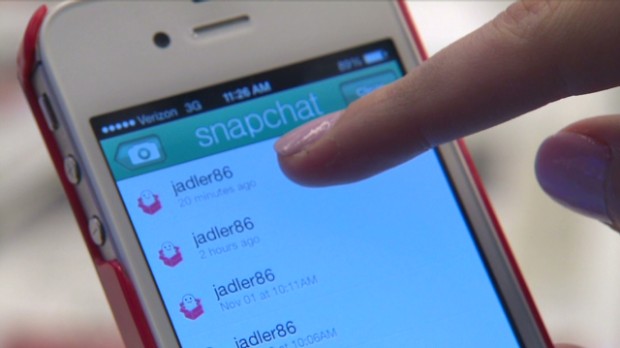
The two-year-old company founded by a group of Stanford undergrads is essentially a mobile photo and video sharing service. It is available for both iOS and Android devices and built around one central premise: anything shared on Snapchat self-destructs. It can either disappear after the recipient (or recipients) view it, or if using the new Snapchat Stories feature, it will vanish 24 hours after it's first posted.
Videos range from 1-10 seconds, and photos can be viewable for that same length of time. Before sharing, users have the option of annotating clips with text and marker tools. After you send your clip out to friends, they'll see it pop up in what essentially looks like an email inbox.
Related: Snapchat as a bright (and long) future
While it's possible to make profiles publicly accessible on Snapchat, it is the furthest thing from Facebook (FB, Fortune 500)-owned Instagram in look and feel. Most people prefer to keep sharing and activity between friends, since that's likely the reason why they started using Snapchat to begin with. But given Snapchat's history, it will be curious to see if they stick with the private, ephemeral aspect as their calling card.
When Snapchat first hit the iPhone App store, it was ambiguously marketed as a sexting app. But when more people started using it to share the dumb, goofy moments of their lives, the startup quickly abandoned that strategy.
Who uses Snapchat? Tech nerds love it because, duh, they are tech nerds.
Teenagers hopped on the bandwagon because the self-destruct mechanism means that posts on Snapchat won't leave a mischief-filled trail of breadcrumbs for authoritarian figures to follow. And people in their 20s are gravitating towards it because people in their 20s actually go out and do stuff and have weird things to share. Or they just want everyone to know they're brushing their teeth.
Though analysts are keen on the service, It's still early to say if Snapchat will join other rarefied Silicon Valley giants like Facebook, LinkedIn (LNKD) and Twitter (TWTR) or if it will fizzle out and be forgotten. But barring Facebook's failed attempt to copy the service with its Poke app, Snapchat offers something that no other major social network does. That just may be enough to tip the scales in its favor. To top of page 

-CNN 

How NASA Will Use 3D Printers in Space


Nasa1
Space-com-4df1ec353a
Starting next fall, astronauts on the International Space Station won't have to wait months for replacement parts to be launched from Earth. Instead, they can use a newly arrived 3-D printer to fabricate the tools and materials they need.
"The 3D printer that we're going to fly on space station will actually be the first-ever 3-D printer in space," Niki Werkheiser, 3-D Print project manager at NASA's Marshall Space Flight Center in Huntsville, Ala., said in a video about the space station 3-D printer that posted online Oct. 30.
"It is the first step toward [the 'Star Trek' replicator]," Werkheiser added, referring to the machine in the science-fiction franchise capable of creating meals and spare parts.

The 3-D printer headed to the space station in August 2014 — a joint project between NASA Marshall and the California-based company Made in Space — would be limited to parts only, rather than edible objects.

Printing in Space

When a tool on the space station breaks or goes missing these days, astronauts must often wait for months for the next supply mission to launch from Earth. The alternative is to ship up multiple spare parts, but the increased mass requires more fuel to lift off, and thus costs more money.
A 3-D printer could change all that, advocates say.
The 3-D printer sent to the ISS will be able to utilize a variety of materials to craft items that the astronauts need, in a more timely manner.
The 3-D printer sent to the ISS will be able to utilize a variety of materials to craft items that the astronauts need, in a more timely manner. As an example, Werkheiser cited an unassuming part known as an extraction tool, which she said could be printed in under an hour. The part would have worked on the space station's Microgravity Science Glovebox, which was out of commission for six months in 2002 while astronauts waited for the needed part to be sent up on the next space shuttle flight.
Another potential application would involve cubesats, which are tiny, low-cost satellites that hitch rides into space on other launches. According to Werkheiser, astronauts on the ISS could potentially print out and assemble many such satellites and manually launch them from the space station.

Demonstration Mission

The first 3-D printer in space will be small enough to fit inside the MSG, and crewmembers aboard the orbiting lab will put their hands inside the glove box to operate it.
NASA hopes the project demonstrates that 3-D printing in space is as robust and reliable as it is on the ground, laying the foundation for a new in-space manufacturing industry.
Made in Space has already tested some versions of the 3-D printer during parabolic airplane flights, which produce short periods of microgravity. A long-term trial aboard the space station is the next step.
"We're starting with plastic with this first printer, but we will be moving to metals and other types of materials," Werkheiser said.
She pointed out that lessons learned from microgravity applications would be applicable on Earth, particularly for remote military outposts and on submarines.
A 3-D printer could be a key piece of equipment for missions traveling beyond Earth's orbit, advocates of the technology say. Rather than packing spare parts and materials that might be needed, astronauts could use the printer to produce what was needed.
"For space station, it will decrease risk, decrease cost, and increase efficiency," Werkheiser said. "For longer-term missions for exploration, this is absolutely critical technology."

-Mashable

Coin Is One Credit Card to Rule Them All

Coin
There are lots of companies, including Google and Apple, that would like to replace your wallet with a digital version, but a startup has a somewhat less ambitious goal — replace your handful of credit cards with one super card.
Coin, a credit-card-like device, is set for a summer 2014 launch. As the video below explains, Coin swipes like an ordinary card. The difference is, the card holds up to eight credit cards, debit cards or gift cards. Coin provides a dongle device to users that connects to their phone and an app that lets you download the card info.
The device will cost $100, but the company is charging $50 for early adopters that preorder now. Founded by former PayPal developer Kanishk Parashar, Coin uses a patent-pending magnetic strip. The reader device employs Bluetooth Low Energy and Coin's battery lasts two years, according to the company.
With so much energy spent towards turning smartphones into digital wallets, Coin's idea seems a bit like a throwback, or at least a stopgap solution until those initiatives go mainstream. (Coin's debut coincided with the U.S. launch of Isis, a mobile wallet initiative backed by AT&T, Verizon and T-Mobile.) Assuming the traditional wallet sticks around for a while, though, Coin might carve its own niche, especially if it can somehow incorporate drivers' licenses, tickets and library cards, among other stubbornly analog forms of ID.

-Mashable

The Wikipedia Articles Iran's Government Doesn't Want People to See

Wikipedia-office
To better understand how the Iranian government censors the Internet at large, researchers at the University of Pennsylvania's Annenberg School decided it was best to look at how the Islamist regime controls one of the Internet's most popular sites: Wikipedia.
Despite the recent election of a reform-minded president, those studying Persian-language Wikipedia through Iranian proxy servers found the government still uses heavy-handed censorship tactics to keep citizens from accessing articles on everything from political assassinations to homosexuality to Emma Watson.
"Understanding what Iranian censors block on the Internet helps demonstrate what information officials find most objectionable as well as the extent to which Iran's Internet censorship policies may violate international law," write the study's authors, Collin Anderson and Nima Nazeri. "Wikipedia, the popular open-source online encyclopedia, provides a useful place to uncover the types of online content forbidden in Iran."
Anderson and Nazeri discovered 936 unique blocked articles out of some 800,000 total Persian Wikipedia entries. And, indeed, there's much to be gleaned by what topics the government chooses to block.
screen_shot_2013-11-13_at_2.15.47_pm.png
Courtesy of Collin Anderson and Nima Nazeri
Of the censored articles, a whopping 75% related to politics, sex or religion. Not surprising from a country whose strict Islamist code has imposed many theocratic rules onto its citizens over the years. Among the most frequently blocked articles were ones related to the Baha'i faith.
"The Baha'i faith is Iran's largest non-Muslim minority religion, and arguably the nation's most persecuted religious group," the study notes. "Iranian religious authorities often regard it as a heretical deviation from Islam."
A strong bend toward religious orthodoxy also leads censors to block access to many pages related to sexuality. Of 189 total censored articles about sex, 52 dealt with specific sex acts, 26 dealt with anatomy, 17 with pornography, 13 with LGBT topics and eight with female clothing, among others.
Censors have also worked at eliminating Western influence. The researchers found eight censored articles about foreign media and journalists, and six omitted entries about Western actresses, including Emma Watson and Kristen Stewart.
When it comes to the censorship of political articles, 129 of the omitted entries related to Iran's contentious 2009 elections. Another 23 entries related to the Green movement that sprang up after that election to protest the re-election of religious hardliner Mahmoud Ahmadinejad.
Fifty-six of the censored 2009 election articles are biographical in nature, providing information about specific protest leaders. This underscores another major trend in Iranian censorship. Half of all blocked pages are about individuals. And half of those people have either been killed or allegedly detained by Iranian authorities. For instance, 23 of those biographical articles are related to the 1990s "Chain Murders" in which the Iranian Intelligence Ministry was publicly implicated in a series of assassinations of leading intellectuals, activists and cultural figures.
screen_shot_2013-11-13_at_2.16.09_pm.png

Courtesy of Collin Anderson and Nima Nazeri Much of the political upheaval and censorship comes at a time when Persian Wikipedia is greatly expanding.
Researchers say the number of articles on the site has increased tenfold since 2006.
Researchers say the number of articles on the site has increased tenfold since 2006. "The legacy of the disputed 2009 elections, the ensuing social upheaval, and the state's repression of protests and activists has given birth to a large number of Wikipedia entries," Anderson and Nazeri write. "Iranian censors have filtered many, if not all, of these entries. Indeed, the state's restriction of free expression by authorities after the 2009 election is mirrored in the patterns of filtration of Wikipedia Persian."
As the study's authors note, these findings come at a time when Iran seems to be at a political crossroads. Following political unrest under the administration of Ahmadinejad, the country has turned to the moderate Hassan Rouhani, who among other notable reforms, has opened up communications with the United States for the first time since 1979.
Rouhani is on the record as saying he believes in the right of all Iranians to access online information, but with the caveat that it must fall within certain legal and cultural limits. But the researchers say these limits run afoul of speech that is protected by international law. The UN's International Covenant on Civil and Political Rights expressly protects speech related to public affairs, human rights, journalism, cultural expression and religious discourse.
"These types of speech and information are exactly what Iranian authorities are blocking on Persian Wikipedia and thus Iran's actions are at odds with its international legal obligations," the report concludes.

-Mashable

Thursday, 14 November 2013

In Slovakia, the Aeromobil flying car makes good

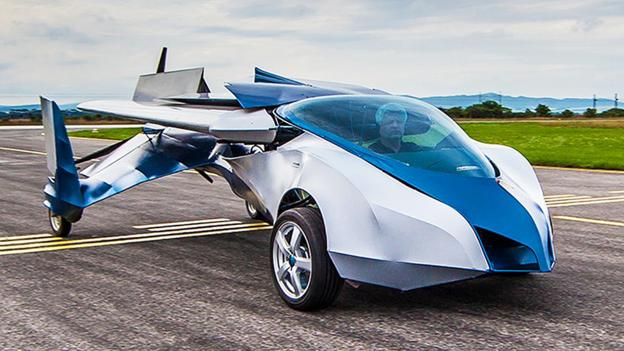
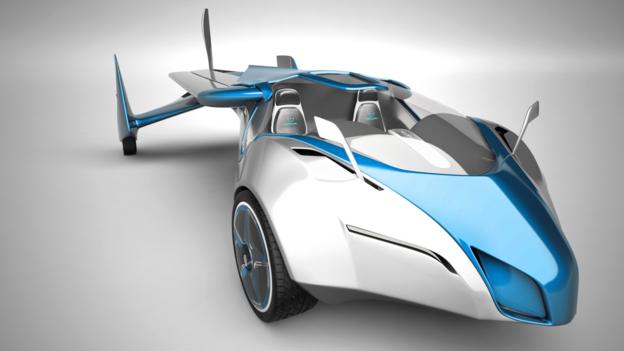
On the heels of the Transition, a prototype air-car created by US-based Terrafugia, comes the Aeromobil, a roadworthy flying car from Slovakia. During testing this week, Version 2.5 of this shapely two-seater proved that it can indeed acquit itself on both road and runway.
The latest prototype in a series that dates to 1990, the Aeromobil 2.5 features carbon fibre body work over a steel chassis. A Rotax 912 light-aircraft power plant – a horizonally opposed 1,211cc four-cylinder engine producing about 100 horsepower – supplies the propulsion on land through the front wheels, and in the air via a three-blade pusher prop. Cruising range (on premium-grade pump gasoline, notes Aeromobil) is 310 miles on land and 430 miles in the air.
The car’s insect-like wings, which sweep back against the body in driving mode, extend to a 27ft span for flight mode. The entire machine tips the scales at a scant 992lbs.
Hardly content with the success of version 2.5, Aeromobil co-founder and head designer Å tefan Klein is hard at work on the more comely and refined Aeromobil 3.0 – which, if Klein has his way, will enter series production in the near future. Interested driver-pilots may want to brush up on their radio patter now.
In the meantime, have a look at Aeromobil’s video of Version 2.5 doing its thing.

-BBC

Will Google Docs kill off Microsoft Office?

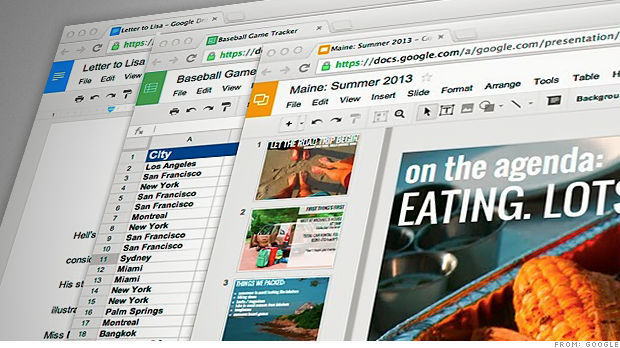
Google Docs offers similar features to Microsoft Office ... on the cloud and for free.
  • 465
    TOTAL SHARES

For years, Microsoft has stockpiled a large amount of cash from sales of its Office productivity software suite.

Yet over the past year, something peculiar happened. Microsoft (MSFT, Fortune 500) has made it easier for consumers to access Office via the cloud and online downloads, regardless of what computer you're using. In the past week, Office even enabled real-time, collaborative document editing for its free offering, Office Web Apps.
Why the big push into making these offline money makers into cheaper cloud services? Blame Google (GOOG, Fortune 500).
When Google Docs first launched in 2006, it was mostly a curiosity. Cloud-based services were not yet a way of life, and support with Microsoft's Office formats was minimal. But Google Docs has been improved upon bit by bit over the past few years and is now an extremely useful and increasingly popular collection of software.
Google Docs is no longer a curiosity. It's a legitimate threat to Microsoft.
Google's productivity tools may lack some of Office's advanced features, but are easier and simpler to use than anything Microsoft offers -- especially when it comes to the cloud-centric features.
Microsoft is still a huge player in this business of course. It claims that Office is installed on more than 1 billion machines. In 2012, Gartner estimated that Office had a 90% market share in the enterprise market.
If you focus on the cloud, however, the story changes.
The next decade looks like Google's to lose. Gartner estimates that in 10 years, there will be 1.2 billion people using productivity suite services ... but more than half of them will be using a cloud-based productivity suite of some sort. Gartner's research also shows Google quickly gobbling up market share in that space. It could be as high as 50%.
Google recently disclosed that there are 120 million accounts using Google Drive (which houses the Docs services), and 5 million businesses and institutions using the Google Apps platform (the latter is not a free service).
As of September, Microsoft has sold 2 million Office 365 Home Premium subscriptions, which allows the suite to be installed on 5 different devices concurrently. Separately, it says that 60% of Fortune 500 business have purchased enterprise versions of Office 365. It also claims to have 50 million users for its Office Web Apps.
Related: Microsoft is the biggest iPhone 5S loser
But Google's suite is quickly becoming the standard for tech startups, small businesses and newer large companies. Demographics are on Google's side as well. Those who have grown up with the Internet don't really think twice about using something that is free, saves your work in a centrally accessible location, and makes it easy to share and collaborate with others.
Office is slowly losing its status as the software of choice. It's becoming something that people just use when they need specialized formatting ... or when they're dealing with someone who only uses Office.
Still, even that is changing. Google's 2012 acquisition of Quickoffice was made to help to bridge the format divide between the two services. And it's even possible to use Google Docs without an Internet connection.
According to a Google spokesperson, the goal isn't to match the Office suite feature for feature. While Google still wants to appeal to the vast majority of traditional Office users, the company is more keen on getting to the point where file format is no longer an issue.
Google can afford to give away software for free. Can Microsoft? Google makes money off its productivity suite by selling web ads. But there is a bigger goal as well. The company is offering services like Google Docs in order to keep users close to its other, more lucrative offerings such as Gmail, Search, Chrome and Maps.
But Office remains a cash cow for Microsoft. Office sales are about a third of the company's total annual revenue. It is not in a position to simply make Office free. With Office 365, Microsoft is charging $100 a year, which guarantees perpetual updates, and has produced modest, but encouraging rewards to the tune of $1.5 billion a quarter. But it's awfully difficult to beat free.
And Microsoft doesn't just face competition from Google. Apple (AAPL, Fortune 500) recently launched its own cloud-based version of its iWork suite. It's giving the mobile iOS version away for free.
Related: Microsoft Office 2013 has nice upgrades, but save your cash
For now, Office is still the overwhelming leader. Still, the tides are shifting. Microsoft probably knows it can't simply rely on its existing install base sticking around just because Office is the standard. In fact, Microsoft should know that from experience.
Microsoft's web browser market share eroded when Firefox, and later Chrome, took center stage. On the enterprise side, its Windows Mobile platform has joined BlackBerry (BBRY) as a victim of Corporate America's embracing of iOS and Google's Android.
This war is far from over, but Microsoft has its work cut out for it. This battle is going to be fought and won in the cloud. And Google, with its years of experience offering consumer services in the cloud, has the home field advantage. To top of page 

-CNN 

Researchers develop new cloaking technology

Researchers at the University of Toronto have found a way to cloak objects from radar by surrounding them with antennas.
STORY HIGHLIGHTS
  • Researchers have found a way to hide objects from radar detectors
  • The cloaking technology covers objects in tiny antennas that create an electromagnetic field
  • Cloaking technology has potential uses for the military and for improving cellular signals
(CNN) -- There are a lot of reasons to want to make things invisible, other than it just being incredibly cool. There are the many potential military uses of cloaking technology, of course, but it could also help improve cellular signals by hiding objects that would normally block and weaken signal strength.
Cloaking technology is popular science fiction trope, but real scientists have been researching and developing new ways to make cloaking objects a reality for years. Most recently, two researchers at the University of Toronto have found a new way to cloak an object using tiny antennas.
In a paper published this week in the journal Physical Review X, they describe their new take on cloaking. They're not making objects invisible to the human eye but making them undetectable by radar. They can even control the signals bouncing back to make objects seem larger or smaller than they really are.
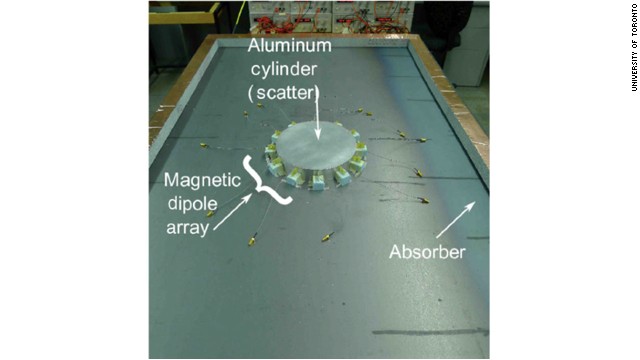
Radar works by sending out electromagnetic waves that reflect off objects and bounce back to the detector. In the past, researchers have made things invisible to radar by redirecting the waves around the object. University of Toronto researchers Dr. George Eleftheriades and Michael Selvanayagam took a different approach more suited to large objects.
The nanoantennas they used radiate an electromagnetic field that prevents waves from reflecting back to the radar detector. The small antennas can be even printed flat to create a flexible skin for the desired object. While the technology only works for radio waves at the moment, the researchers say the same principals could be applied to other waves such as light waves, which could potentially hide an object from the human eye.
In their demonstration, Eleftheriades and Selvanayagam tested the antennas on an aluminum cylinder. Currently, the antennas need to be manually set to the proper frequency they're blocking, but in a more advanced set up, they could detect the different waves and adjust accordingly.
There have been numerous other attempts to make things disappear.
In March, researchers at the University of Texas in Austin created a material that could be used to cancel out the microwaves bouncing off an object. Researchers at Michigan Technological University have experimented with cloaking objects from microwave and infrared frequency waves using shells of nonconductive materials such as ceramics and glass metamaterial to distort waves.
A professor in Japan used cameras to film a scene and then project it on an object in front of that area onto a special reflective material, creating a visual camouflage.
It's going to a long while before we're picking up our own personal cloaking devices at the local Best Buy. But new research in this field is constantly tacking new, wider bandwidths and experimenting with less cumbersome technology that can be used on larger devices.

-CNN
The Most Profitable New Reader Demographic: Robots

175074226
The-atlantic-067534c5d3
Here is the weirdest thing about the modern Web: humans are only one constituency and maybe not the most profitable one.
Consider the case of an anonymous publishing executive who spoke with the media trade magazine Digiday about purchasing bulk robot traffic to his former company's website.
By robot, I mean software that is designed to simulate a human being browsing the Web. Bots, as they are known, are relatively easy to create, and now you can easily purchase their services to build a nice business, if you are willing to bend the rules of digital publishing.

Arbitrage ... Now With More Robots

In this case, the publisher paid $10,000 to $35,000 for the cheapest possible traffic, which companies domiciled outside the United States could provide for about $0.002 per visit. Then, they turned around and sold those visits for between $0.0025 and $0.004 through advertising networks, which act as clearinghouses for bulk advertising buys across the Web.
That's a pretty weird media business model, but it doesn't take a genius to realize this is a good arbitrage opportunity. Even if you only make one-tenth of a penny per visit, it's not that expensive to buy millions of visits, so you can make some serious money.
Let's do the math here. They were getting between 5 and 17.5 million visits per day and selling them for a fraction of a penny more to generate between $12,500 and $70,000 in revenue per day.
If they maxed out every day, buying the most traffic possible and selling it at the highest price, they'd make $2.1 million a month without ever creating anything that a human might want to look at.

But Isn't This Fraud?

Yes, it is certainly fraud in the colloquial sense and may be fraud in the legal sense, too, as the publishing executive readily admitted. Robots don't buy anything, and showing them ads remains ineffective.
The providers of the nonhuman traffic do not acknowledge that they are sending bots to load Web pages.
The providers of the nonhuman traffic do not acknowledge that they are sending bots to load Web pages. They tell the publishers that the traffic will be of "unknown quality." This is the code word. The publishers know that "unknown quality" means "unknown robots," but they sell ads anyway. And yet, the bots (at least the cheap ones) leave tell-tale tracks in the analytics software that companies use to track their visitors.
"You can tell it’s bot traffic just by looking at the analytics. We’d see a traffic spike in our real-time analytics dashboard and then we would see all of our traffic for the day serve in a couple of hours," the publisher told DigiDay. "Or it would all come from users using the same really old version of Internet Explorer. Almost all our users had Flash versions from 2003, according to Google Analytics. That just doesn’t happen with real users."
In other words, detecting the simplest bots probably isn't hard. But ad networks don't really want to know about the makeup of their visitor pool because it might hurt their businesses. Same goes for publishers.
So, strangely, for now, there's a really tidy profit to be made showing Web pages to robots.

-Mashable

Mars Rover Curiosity Recovers From Software Glitch

Rover
Space-com-4df1ec353a
NASA's Curiosity rover has bounced back from a glitch that put the 1-ton robot into a protective "safe mode" for three days over the weekend.
The car-size Curiosity rover went into safe mode Thursday, a few hours after receiving a software update from its handlers on Earth. But mission engineers have identified and fixed the problem, allowing Curiosity to resume normal operations on Sunday, NASA officials said.
"We returned to normal engineering operations," Rajeev Joshi, a mission software and systems engineer at NASA's Jet Propulsion Laboratory in Pasadena, Calif., said in a statement Tuesday. "We are well into planning the next several days of surface operations and expect to resume our drive to Mount Sharp this week."

Curiosity began heading toward the towering Mount Sharp in early July and has covered about one-third of the 5.3-mile-long trek to date, NASA officials said recently.
The recent glitch was caused by an error in Curiosity's onboard software, which resulted in an error in a catalog file, mission team members said. When the new version of Curiosity's software processed the faulty catalog file on Thursday, the rover automatically rebooted its software and went into safe mode.
"The team was able to replicate the problem on ground testbeds the following day," NASA officials wrote in a mission update Tuesday. "Commands recovering the spacecraft were uplinked to the spacecraft early Sunday morning."
Curiosity has been exploring Mars' 96-mile-wide Gale Crater since August 2012, when it aced a daring and unprecedented landing that saw the rover lowered to the Red Planet's surface by a rocket-powered sky crane.
The mission's chief goal is to determine if Mars has ever been capable of supporting microbial life. Curiosity has already answered that question in the affirmative, finding evidence that a site called Yellowknife Bay was indeed habitable billions of years ago.
The mission is far from over, however. Mission scientists are excited to explore the 3.4-mile-high Mount Sharp; they want Curiosity to climb up through the mountain's foothills, reading the history of Mars' changing environmental conditions as it goes.

-Mashable