Follow us

Pages

Thursday, 19 December 2013

Jonathan unveils Nigeria’s first indigenous unmanned aerial vehicle

Kaduna – President Goodluck Jonathan on Tuesday in Kaduna unveiled the country’s first indigenous unmanned aerial vehicle, GULMA, designed and constructed by the Nigerian Air Force.
Speaking at the ceremony, Jonathan said that the unveiling of the vehicle marked another landmark moment in the nation’s history.
He said that besides its diverse military application, the vessel would provide a range of benefits in disaster management, power line surveys and law enforcement.
Jonathan said that the vehicle would also be useful in aerial imaging/mapping, telecommunications and weather monitoring.
“It is also rapidly becoming an important tool in news coverage, environmental monitoring, and oil and gas exploration.
“Considering the potential impact of its benefit and versatility, I cannot but say how proud I am of the men and women of our Armed Forces.
“Apart from their commitment to the protection of our sovereignty, they are helping to keep our nation ahead in military science and technology and to keep their civilian counterparts on their toes.
“Today, as we stand in appreciation of the gallant men and women of our Air Force, we are reminded that hard work and diligence can break many barriers,’’ he said.
Jonathan commended the Chief of Air Staff and all officers and men of the Nigerian Air Force for the achievement, noting that it would strengthen the country.
He said it would also enhance the nation’s role in peace keeping and conflict prevention.
The president said he was optimistic that this stride by the Nigerian Air Force would mark a turning point for indigenous technology in every sector of the nation’s life.
“Let me assure the Air Force of the Federal Government’s support for this and all other research projects.
“We will encourage and assist private sector concerns to key into mass production of the project to achieve the highest and best commercial use of this prototype Unmanned Aerial Vehicle.
UNVEILING OF 'GULMA' NIGERIA'S FIRST INDIGENOUS UNMANNED AERIAL VEHICLE IN KADUNA
UNVEILING OF ‘GULMA’ NIGERIA’S FIRST INDIGENOUS UNMANNED AERIAL VEHICLE IN KADUNA
“As I said in my Independence Day address, our nation is made great by the big and small efforts of regular citizens.
“Indeed, indigenous initiatives remain indispensable in achieving national greatness.
“To retain the country’s importance on the global stage, we must continue to produce leaders in science, technology, and engineering, and invest more in ideas,’’ the president said.
In his remark, Supervising Minister of Defence Labaran Maku said the development of a surveillance aircraft by the Nigerian Air Force was a bold statement of government’s resolve to provide security for the Nigerian populace.
Maku, who is the Minister of Information, said that the GULMA UAV would potentially afford the armed forces a window of immense opportunities in its task of acquiring timely intelligence and combating criminality.
“Although the UAV was a brainchild of the Nigerian Air Force, it is important that other services and security agencies incorporate it into their operations, if its potential is to be fully harnessed.
“There is therefore, the need for a comprehensive policy on UAV acquisition and operation to optimise the employment of GULMA UAV by all services and security agencies,’’ he said.
Earlier, the Chief of Air Staff, Air Marshal Alex Badeh, had said that the GULMA was designed to meet vast expectations and needs.
Badeh said that the GULMA could be employed by the armed forces and security agencies for the protection of the country.
He explained that the air force envisaged partnership with agencies such as NEMA and the Nigeria Air Space Management Agency for weather forecasting.
“Furthermore, the GULMA, as a qualitative, timely and reliable source of information could serve as a powerful tool for media practitioners.
“To sustain the current tempo of development, the NAF would require the assistance of government in infrastructure and human capacity development. (NAN)
- See more at: http://www.vanguardngr.com/2013/12/jonathan-unveils-nigerias-first-indigenous-unmanned-aerial-vehicle/#sthash.Kz7FgRsg.dpuf
Kaduna – President Goodluck Jonathan on Tuesday in Kaduna unveiled the country’s first indigenous unmanned aerial vehicle, GULMA, designed and constructed by the Nigerian Air Force.
Speaking at the ceremony, Jonathan said that the unveiling of the vehicle marked another landmark moment in the nation’s history.
He said that besides its diverse military application, the vessel would provide a range of benefits in disaster management, power line surveys and law enforcement.
Jonathan said that the vehicle would also be useful in aerial imaging/mapping, telecommunications and weather monitoring.
“It is also rapidly becoming an important tool in news coverage, environmental monitoring, and oil and gas exploration.
“Considering the potential impact of its benefit and versatility, I cannot but say how proud I am of the men and women of our Armed Forces.
“Apart from their commitment to the protection of our sovereignty, they are helping to keep our nation ahead in military science and technology and to keep their civilian counterparts on their toes.
“Today, as we stand in appreciation of the gallant men and women of our Air Force, we are reminded that hard work and diligence can break many barriers,’’ he said.
Jonathan commended the Chief of Air Staff and all officers and men of the Nigerian Air Force for the achievement, noting that it would strengthen the country.
He said it would also enhance the nation’s role in peace keeping and conflict prevention.
The president said he was optimistic that this stride by the Nigerian Air Force would mark a turning point for indigenous technology in every sector of the nation’s life.
“Let me assure the Air Force of the Federal Government’s support for this and all other research projects.
“We will encourage and assist private sector concerns to key into mass production of the project to achieve the highest and best commercial use of this prototype Unmanned Aerial Vehicle.
UNVEILING OF 'GULMA' NIGERIA'S FIRST INDIGENOUS UNMANNED AERIAL VEHICLE IN KADUNA
UNVEILING OF ‘GULMA’ NIGERIA’S FIRST INDIGENOUS UNMANNED AERIAL VEHICLE IN KADUNA
“As I said in my Independence Day address, our nation is made great by the big and small efforts of regular citizens.
“Indeed, indigenous initiatives remain indispensable in achieving national greatness.
“To retain the country’s importance on the global stage, we must continue to produce leaders in science, technology, and engineering, and invest more in ideas,’’ the president said.
In his remark, Supervising Minister of Defence Labaran Maku said the development of a surveillance aircraft by the Nigerian Air Force was a bold statement of government’s resolve to provide security for the Nigerian populace.
Maku, who is the Minister of Information, said that the GULMA UAV would potentially afford the armed forces a window of immense opportunities in its task of acquiring timely intelligence and combating criminality.
“Although the UAV was a brainchild of the Nigerian Air Force, it is important that other services and security agencies incorporate it into their operations, if its potential is to be fully harnessed.
“There is therefore, the need for a comprehensive policy on UAV acquisition and operation to optimise the employment of GULMA UAV by all services and security agencies,’’ he said.
Earlier, the Chief of Air Staff, Air Marshal Alex Badeh, had said that the GULMA was designed to meet vast expectations and needs.
Badeh said that the GULMA could be employed by the armed forces and security agencies for the protection of the country.
He explained that the air force envisaged partnership with agencies such as NEMA and the Nigeria Air Space Management Agency for weather forecasting.
“Furthermore, the GULMA, as a qualitative, timely and reliable source of information could serve as a powerful tool for media practitioners.
“To sustain the current tempo of development, the NAF would require the assistance of government in infrastructure and human capacity development. (NAN)
- See more at: http://www.vanguardngr.com/2013/12/jonathan-unveils-nigerias-first-indigenous-unmanned-aerial-vehicle/#sthash.Kz7FgRsg.dpuf

Monday, 9 December 2013

Wearably Brings RSS Feeds to Google Glass

With more wearable devices entering the market, the way we read online content could change significantly. Instead of taking out a smartphone, readers of the near-future will more often read from devices like Google Glass or the Galaxy Gear.
A new service makes it easier for content from RSS feeds and websites to transition to wearable technology. Wearably helps publishers display their content on wearable devices such as smartwatches or Google Glass.
Atlantic Media, National Geographic and NPR already use the service, created by a three-person team called Silica Labs. The company's biggest selling point is its ability to help companies keep up with the rapidly changing digital content arena while saving money. Silica Labs co-founder Marvin Ammori told Mashable that customers come to the company because they know it will avoid "costs that are more unpredictable."
Wearably screenshot
Originally called SimpleWing, Wearably allows users to create Google Glass apps similar to the ones created by CNN and Elle.
The service takes the important elements of an article — headline, photographs, time of publication — and transfers them to interactive cards designed to be viewed on wearable devices. Users simply install the Wearably app and then subscribe to certain outlets. Because many websites publish content throughout the day, the service allows users to organize news into morning and evening editions.
Wearably CTO Antonio Zugaldia told Mashable that publications can organize their content as they wish. National Geographic, for example, dedicates one section entirely to photographs.
"It's totally up to the publication how they organize their content," says Zugaldia. "Our responsibility is to deliver the content to users in a beautiful way."
Zugaldia also explained that the biggest challenge during the development of Wearably was working with so many different devices, which meant a variety of application programming interfaces (APIs). In addition, the team does not want to overwhelm users with content.
As designer and co-founder Stephanie Nguyen says, these devices can affect how users read content. "
What we're hoping to do is re-imagine the way users consume news
What we're hoping to do is re-imagine the way users consume news," says Nguyen. To use the service, individuals pay $11 a month while big publishers pay $449 a month. The publisher plan guarantees distribution of one RSS feed onto Google Glass, the Sony Smartwatch 2 and the Pebble Watch.
Ammori also revealed that the team is working on developing a way to bring news to users based on their location and eventually deliver city-wide alerts to users' devices.

BONUS: 7 Standout Google Glass Apps You Can Download Right Now
Have something to add to this story? Share it in the comments.

Google, Microsoft Lead Campaign to Limit Government Surveillance

Surveillance
Eight technology giants, including Google and Microsoft, have started a public campaign to limit government surveillance of users, The New York Times reports.
The companies — Google, Microsoft, Apple, Facebook, Twitter, AOL, LinkedIn, and Yahoo — published an open letter in national newspapers and opened a website at reformgovernmentsurveillance.com (which, curiously, doesn't work at the time of this writing).
In the letter, the Reform Government Surveillance group is calling for the U.S. President and Congress to limit surveillance of people, as it "undermines" their freedoms.
"We understand that governments have a duty to protect their citizens. But this summer's revelations highlighted the urgent need to reform government surveillance practices worldwide," the letter said.
“The balance in many countries has tipped too far in favor of the state and away from the rights of the individual — rights that are enshrined in our Constitution. This undermines the freedoms we all cherish.”
The initiative comes after a string of leaks this summer, detailing the NSA's extensive surveillance of users, including spying on data centers of Google, Microsoft, Yahoo and other tech companies.

Mashable

Thursday, 5 December 2013

Microsoft developed a 'smart' bra

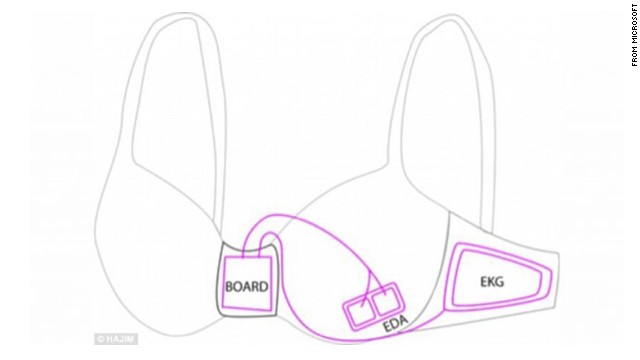
Microsoft researchers are developing a bra with sensors that could monitor a woman's emotional state to combat overeating.

(CNN) -- It's no longer enough to have smartphones, smartwatches, smart TVs and smart cars. Now a tech company is bringing artificial intelligence to lingerie.
Researchers at Microsoft have developed a prototype of a "smart bra" embedded with physiological sensors that seek to monitor a woman's heart activity to track her emotional moods and combat overeating. The sensors can signal the wearer's smartphone, which then flash a warning message to help her step away from the fridge and make better diet decisions.
The company says it has no plans to make the bra into a commercial product, however.
So -- why a bra, exactly?
"First, we needed a form factor that would be comfortable when worn for long durations," said scientists in a research paper published online. "The bra form factor was ideal because it allowed us to collect (electrocardiogram data) near the heart."
Research has shown that many people reach for calorie-rich foods like doughnuts when they're feeling stressed, bored, discouraged or on edge. There's a reason it's called comfort food.
For the research paper, scientists from Microsoft, the University of Rochester and the University of Southampton in the UK interviewed women who said that interventions -- being alerted to their emotional states -- helped them identify triggers for binge eating.
The researchers then conducted a study in which four women wore the sensors in their bras for four days to monitor their vital signs. An electrocardiogram (EKG) sensor under the arm measured their heart rate, while an electrodermal activity (EDA) sensor tracked their perspiration.
The researchers determined the bra was mostly effective in detecting its wearer's emotional changes. But the sensors needed to be recharged every three to four hours, which limited how long the bra could be worn. And more research would be needed before a smart brassiere -- Microsoft's Secret, anyone? -- ever became a viable product.
A Microsoft spokesperson downplayed the bra's significance in an e-mail to CNN.
"The bra sensing system is just one instance of a class of work from a group of Microsoft researchers that is focused on the broader topic of affective computing, or designing devices and services that are sensitive to people's moods and react accordingly," the spokesperson said.
"While we will continue our research in affective computing, Microsoft has no plans to develop a bra with sensors."
What about a similar undergarment for men? Researchers didn't rule it out.
"We will continue to explore how to build a robust, real-world system that stands up to everyday challenges with regards to battery life, comfortability, and being suitable for both men and women," the researchers said in the paper.
Reaction to the bra on Twitter ranged from amusement to annoyance.
"Anyone else offended that Microsoft is devoting its tech research to a bra designed to prevent women from overeating?" tweeted a Seattle woman whose Twitter handle is @cunningminx.
Added Rachel Happe of Boston, "If nothing else convinces you we need more women in tech, this should. No, I don't want someone hacking my bra..."

Nissan to build cars in Nigeria

Nissan Patrol 
Nissan will become the first global carmaker to build cars in Nigeria since west Africa’s largest economy rolled out a policy to tempt investors into its nascent automotive industry.
The Japanese carmaker, which has aggressively targeted growth in emerging markets as the centrepiece of its global strategy, plans to build 45,000 cars a year in the country, likely starting with an SUV early next year.

Nissan, which last month announced it would be the first international carmaker to build vehicles in Myanmar, targets a doubling of sales in Africa to 220,000 by 2016.
Nigeria, which imports millions of dollars worth of new and used cars into the country every year, has embarked on a drive to attract manufacturing and industrial investments into the country since former Goldman Sachs banker Olusegun Aganga was made minister of trade and investment this year.
While it is sub-Saharan Africa’s biggest recipient of foreign investment with roughly $7bn last year, or about 14 per cent of the region’s total, investors complain that Nigeria remains a challenging destination for industrial ventures because of a lack of power supply, poor transport infrastructure and an unskilled labour force.
African countries, long overlooked by global carmakers, are seen as one of the last remaining untapped sources of growth for the industry, after heavy investments in recent decades in India, China and southeast Asia.
“Nissan is preparing to make Nigeria a significant manufacturing hub in Africa,” said chief executive Carlos Ghosn, the global car industry’s most prominent believer in emerging market potential. “As the first-mover in Nigeria, we are positioned for the long-term growth of this market and across the broader continent.”
The UN Conference on Trade and Development puts Nigeria as the fourth-best destination for foreign direct investment when measured by returns, only behind Angola, Bahrain and Kyrgyzstan. Unctad estimates that FDI projects returned on average 36 per cent in Nigeria in 2011, compared with an average for emerging markets of 8.4 per cent.
Volkswagen and Peugeot previously built cars in Nigeria but have since closed factories.
The global alliance between Nissan and French partner Renault signed a memorandum of understanding with Nigerian company Stallion Group to begin vehicle assembly in Lagos, the alliance said on Wednesday.
Renault is mulling the possibility of joining Nissan in building cars in the country, a spokesman for the alliance said.
The entry is the first since Nigeria’s government unveiled a new automotive industrial policy designed to encourage carmaking. The Japanese company will build cars, light duty trucks, pickups and vans in the country, it said.
It also has a factory in Morocco and in South Africa, where it will begin production of its relaunched low-cost Datsun cars by the end of next year.

Wednesday, 4 December 2013

This Technology Tags Your Photos Based on Relationships

Since 2010, Facebook has used facial recognition software to automatically tag your friends in photos. Now one researcher has come up with an algorithm that tags photos based on the relationships that people in images already have with each other.
The algorithm uses the name and location of existing photo tags to build a "relationship graph," where personal connections in the images are calculated. That makes it faster and more efficient at tagging pictures compared to what's currently used by sites such as Facebook and Flickr.
For example, if a father and daughter appear in tagged images consistently, untagged photos featuring them can be tagged automatically. If the daughter is in an image with both of her parents, but the father is untagged, the algorithm is able to recognize him based on their other images together.
University of Toronto engineering professor Parham Aarabi has been working on the technology since 2005. He emphasizes the advantages of the algorithm over Facebook's face-recognition photo tagging system.
"The goal of face recognition is to find or generate a new tag when there is none," Aarabi told Mashable. "By using the tag locations and generating a relationship graph, we are essentially extracting the meaning from photos without significant computational analysis — since we only analyze the name and location of a particular tag, not the pixels of the entire image."
Aarabi has not yet been in touch with Facebook or other photo sharing sites about the algorithm technology. It will be patented by the United States Patent and Trademark Office on Dec. 17.

Tuesday, 3 December 2013

Amazon Unveils Flying Delivery Drones on '60 Minutes'

Amazon founder and CEO Jeff Bezos is known for making big bets in the world of innovation, and on Sunday night on 60 Minutes he revealed what might be one of his biggest: product delivery by flying robot drones.
The service is called Amazon Prime Air and it's slated for rollout sometime in 2015, depending on FAA approval.
A video of how the service will work has already been posted to YouTube, showing the process of the package being taken from the warehouse floor and on to the front steps of the customer’s home. The idea is to have the drone deliver orders roughly 30 minutes after the customer hits the “buy” button on Amazon.com.
2amzndron09870df
Bezos was so excited about the news that he kept the details under wraps until just before the interview with the network began. According to the producers of 60 Minutes, before the unveiling, Bezos said, “If you can guess what it is, then... I will give you half my fortune and send you to Vegas with it.”
Reacting to the unveiling of the Amazon-branded drone, Bezos interviewer Charlie Rose said, “I had no idea what its purpose was at first glance… They actually look like something out of a Philip K. Dick novel.”
You can watch the entire interview on the 60 Minutes website.

Yahoo Buys Startup SkyPhrase to Improve Web Searches

Marissamayer
Yahoo announced on Monday it acquired startup SkyPhrase to make finding what you want online easier, without using disjointed words and phrases in the search form.
The company said via a blog post SkyPhrase will be joining its Yahoo Labs team in New York. The four-person startup gained popularity earlier this year for its software that turns inquiries written in natural language into something the database understands.

The platform will allow Yahoo web users to get more personalized search results when entering various queries, such as "Find an American Airlines flight next week from New York to Los Angeles."
"In Yahoo, we have found a company that not only shares our vision, but delivers a rich collection of information and services to a massive user base. We are excited to join Yahoo Labs to continue to work on our shared vision of making computers deeply understand people's natural language and intentions," SKyPhrase said in a statement. "We can’t wait to take things to the next level together."
Yahoo hasn't revealed financial details related to the deal.
SkyPhrase joins the long list of startups acquired this year by Yahoo, from Tumblr to app maker Lexity and media aggregator Summly.

10 Excellent Platforms for Building Mobile Apps

Mobile-app-builders
If you've ever wanted to build an app for your business, blog, product or service, but the heavy investment of both time and money put you off, you're not alone.
The good news is that entering the mobile market no longer necessarily requires thousands of dollars and months of work. There are many mobile platforms available to help you build an app on a budget — quickly, and with no coding knowledge required.
With a small investment, you can create and manage your mobile site or application using one of the platforms listed below, and start reaping the advantages of offering your customers a dedicated mobile experience, including increased awareness, engagement and revenue.
  • 1. Appery

    1-appery
    Appery is a cloud-based mobile app builder that you can use to create apps for Android, iOS and Windows Phone, and includes Apache Cordova (Phone Gap) with access to its built-in components.
    Since the builder runs in the cloud, there's nothing to install or download, and it's easy to get started quickly. It includes a visual editor using drag and drop components to build the UI. You can connect to any REST API and use it in your app, and instantly add a cloud database and backend to your app if you need to store data.
    You can add powerful functionality with the Appery plugin catalog, or create your own custom private plugins to use in your apps. Collaboration is simple, allowing you to share your mobile project with development teams, business users and customers in real time.
    Price: Plans start at Free and go up to $180 per month for Premium
    Image: Appery
  • 2. Mobile Roadie

    2-mobileroadie
    Mobile Roadie is an app creator that allows anyone to create and manage their own iOS or Android app. The platform supports all media types, with automatic importing of RSS, Twitter or Google News keywords, and an auto-refreshing fan wall through which users can chat with each other in real time.
    You can use the free Mobile Roadie Connect app to preview your app accurately, just as your users would on their devices. The app also guides you through the submission process, with Mobile Roadie checking the quality and appropriateness of your content.
    You can push content straight to your app and pull content from it to your own site or blog. The API is language agnostic, so you can pull data in a variety of formats, including XML, JSON, PHP, CSV and HTML. You can easily craft a custom look and feel for your app and apply that to all platforms, and use the suite of marketing tools once your app is launched.
    Price: Plans start at $125 per month (Core) and go up to $667 per month (Pro).
    Image: Mobile Roadie
  • 3. TheAppBuilder

    3-appbuilder
    TheAppBuilder provides a suite of apps to suit employees, clients, events and brochures, with two different approaches available. You can build the app using the online toolkit, and either the training provided or TheAppBuilder itself will work with you to define and build the structure of the app and populate it with initial content.
    Using the dedicated AppLibrary, you can provide your users with a window into multiple apps and even customize it with your own branding. You can protect both public and private apps with usernames and passwords, and distribute them via the app store, making use of TheAppBuilder's Active Directory integration to enable login with existing credentials and user groups.
    Updating the structure and content of your apps is easy, even after you go live, because you can make unlimited updates and publish on multiple mobile platforms in one click. The platform supports native iPhone, iPad and Android, with updates going live within 60 seconds of submitting a change.
    Price: Pricing available upon request
    Image: TheAppBuilder
  • 4. Good Barber

    4-goodbarber
    Good Barber provides a platform to build iPhone and Android apps, allowing you to take control of every detail of your app without producing a single line of code. Nine colorful, highly customizable design templates are available to get started, with 350 beautiful icons and access to over 600 Google Fonts.
    Along with native iPhone and Android apps, you have a free web mobile version, which users access from their phones' browsers. You can also link this to your domain name, if you want it to become the official mobile version of your website.
    You receive immediate visual feedback every time you adjust any parameters in your app. Send unique, actionable push notifications and convert your readers into contributors by letting them submit articles, photos and videos. You can also organize your app and add sections ranging from videos, photos, sounds, live events and more.
    Price: Plans start at $16 per month and go up to $32 per month for the Full Plan
    Image: Good Barber
  • 5. Appy Pie

    5-appypie
    Appy Pie is a cloud-based DIY mobile app creation tool that allows users without programming skills to create an app for Windows, Android and iOS, and publish it to Google Play or iTunes. There's nothing to install or download -- just drag and drop pages to create your own mobile app online. Once it's complete, you receive an HTML5-based hybrid app that works with all platforms, including Blackberry. All revisions are in real time, with the ability to send push notifications, monetize with ads, see live analytics, and track location with GPS. You can also integrate social media feeds, blogs, websites, audio, radio and more.
    The appointment scheduler is especially useful for businesses such as Doctors, Salons or Spas with contact features such as one touch call, QR codes included. Using the code page you can embed custom code and embed iframes.
    Price: Plans start at Free and go up to $33 per month for Platinum
    Image: Appy Pie
  • 6. AppMachine

    6-appmachine
    AppMachine is an easy-to-use platform to build and design professional native apps for both iOS and Android. Using the drag-and-drop interface, you can combine different building blocks that offer a variety of features, such as information, photos and video. The building blocks also let you link your app to Facebook, Twitter, or online stores. You can design the app in your own unique style and choose your navigation paths, colors, fonts and icons, taking complete control of layout and watching your progress using the Previewer.
    Test your app as you build it and check its progress on your computer, mobile or tablet. Once your app is fully tested and ready to go, you can publish and promote your app, and analyze the user data. AppMachine takes care of everything you need to get your app into Apple's App Store and Google Play.
    Price: Plans are one-time fee only, and start at $499 (Gorgeous) and go up to $899 (Designer). A $1299 option (Developer) will be available soon.
    Image: AppMachine
  • 7. GameSalad

    7-gamesalad
    GameSalad allows you to create and publish games for a variety of platforms, including iOS, Android, HTML5 and OS X. Its drag-and-drop interface allows you to get started quickly, without the need for any programming knowledge.
    The game creator features a scene and actor editor, where you spend most of your game creation time, setting up actors in a scene and creating attributes, images, sounds and navigating between actors. The active community forum is a huge plus, with access to help and advice from fellow independent game designers.
    GameSalad recently teamed up with Amazon to offer access to development options specifically optimized for the Kindle Fire platform, including drag-and-drop integration with in-app purchase and GameCircle APIs.
    Price: Plans start at Free and go up to $299 per year for Pro
    Image: GameSalad
  • 8. BiznessApps

    8-biznessapps
    BiznessApps provides a platform to help create mobile apps for businesses a very simple process. It provides a wealth of features, including food ordering, shopping cart, loyalty programs, dynamic content, third party integrations, push notifications, comprehensive analytics and more.
    The easy-to-use content management system allows you to create an app in minutes, and customize everything using pre-built designs or your own. There are also real-time previews to check your progress as you design and develop your app.
    You can instantly update your app online, and modify everything inside, without having to send your app for a lengthy update with Apple or Google. There are weekly webinars on how to build beautiful mobile apps using the BiznessApps platform, along with access to hundreds of tutorial articles, to help make the process even easier.
    Price: Plans start at $29 per month for mobile website and go up to $59 per month for mobile app
    Image: BiznessApps
  • 9. AppMakr

    9-appmakr
    AppMakr is a DIY app creation platform that lets anyone craft iOS, Android and HTML5 apps, with no coding knowledge required. It was founded in 2009, and recently acquired by Infinite Monkeys, to now form one of the largest DIY app publishing platforms worldwide.
    You can make as many apps as you want, with unlimited updates, and utilize a number of features, including push notifications, high resolution photo galleries, live updates, music and video streaming, chat rooms, Google Maps integration, shared events calendars, in-app shopping, and much more.
    You keep track of all your apps through the Dashboard, easily customize your app's looks and functionality, add content with tabs, preview your app in real time and publish it to the markets with a single click.
    Price: Plans start at Free and go up to a $99 one-time fee for Self-Publish
    Image: AppMakr
  • 10. ShoutEm

    10-shoutem
    ShoutEm offers an app builder with complete content management, powerful user engagement tools and monetization options, coupled with a seamless publishing process, to provide a robust solution for most requirements. The interface builder offers many customization options, and each app can be tightly integrated with existing content sources such as WordPress, Foursquare, Facebook, Twitter, SoundCloud and more. The multiple monetization options means you can quickly create a revenue stream from your app, providing an e-commerce experience, in-app subscriptions, deals and coupons, with support for all major ad networks included.
    You can publish your apps under your developer account to both iTunes and Google Play, and update your app or content in real-time. ShoutEm also offers regular auto-updates, to ensure your app is always ahead of new iOS and Android updates.
    Price: Plans start at $19.90 per month and go up to $119.90 per month for Unlimited